First big gun – Pioneer SX-9000

•November 16, 2012 • 3 Comments

Image

Early in to my vintage stereo hobby, I thought it would be cool to try and replicate the system that I remember from my childhood – my Dad’s all-Pioneer rig brought back from the PX in South Korea after his stint in the Army in 1972. He had a Pioneer SX-9000 receiver, a pair of Pioneer CS99a main speakers, some CS-06As, a TEAC reel-to-reel, and a Garrard 0/100 turntable. I remember trying to record a four-track punk masterpiece through that stereo and the tape player while in a promising local high school garage band. We actually used that receiver and the CS99As as a PA system once. 

It punched hard and played well. 

And so there was really no saying ‘no’ when I found an SX-9000 in good shape in the local CL. It had been owned by a vet who brought it back from Vietnam. It was spotless. The only problem was that it was a little scratchy on the volume, and the little speaker wire plugs in the back were missing. 
Image

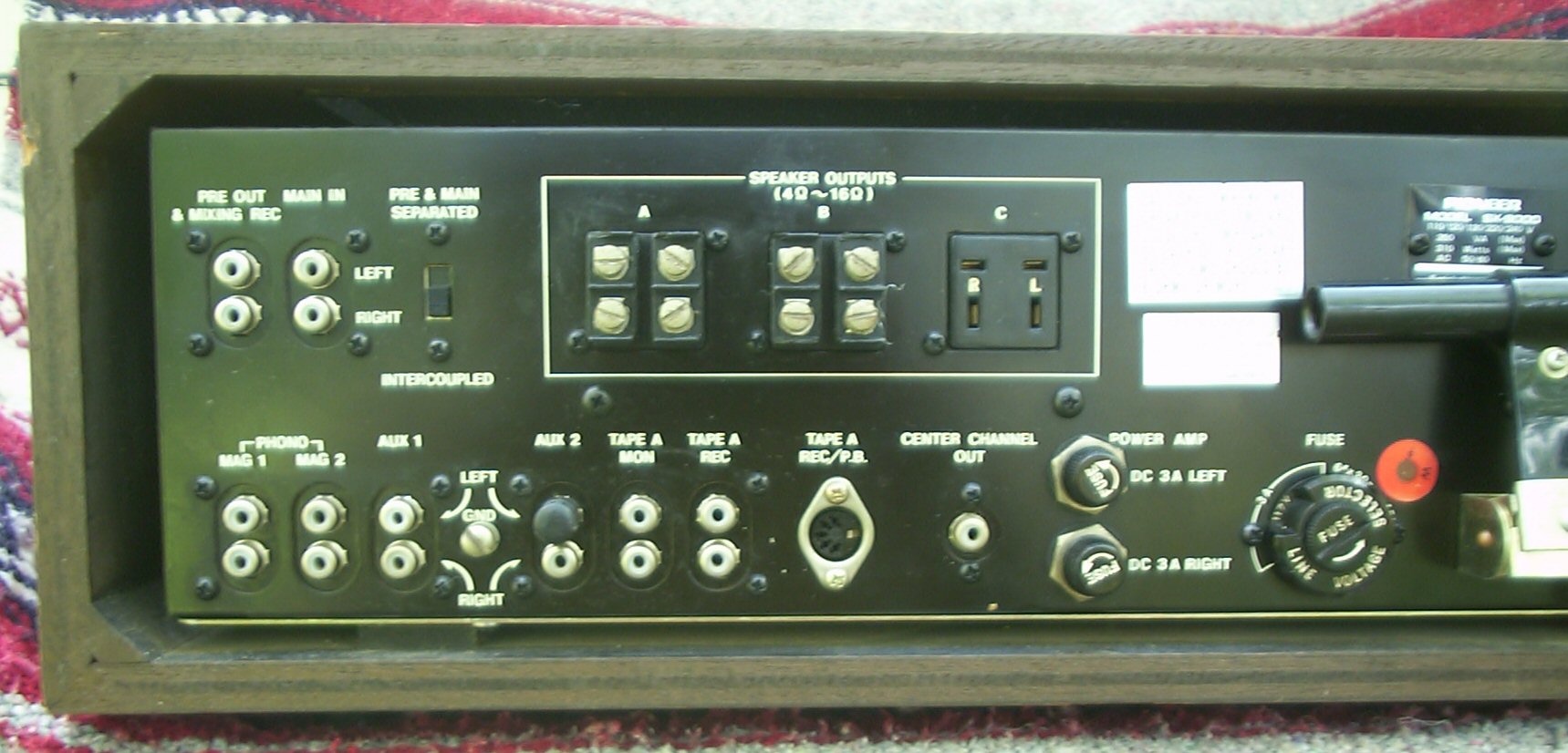
Pioneers (and likely some other brands of the era) used these little DIN speaker plugs in the back of the receivers – you screwed the speaker wires into them, and then they plugged into the amp. I don’t know why they went with this solution, but it means that almost any receiver of that period that you now find has lost these important little widgets, which Pioneer is happy to sell you at $8 per. I was happy to fork over the money. 

What a monster! It may only state 60 or so watts per channel, but this thing is a tank. It can take three sets of speakers, two mics, two tapes, phono, two aux inputs, and who knows what else – this was from the era when a receiver was the home entertainment solution, and evidently many people were into overlaying their own voice tracks onto tape.  

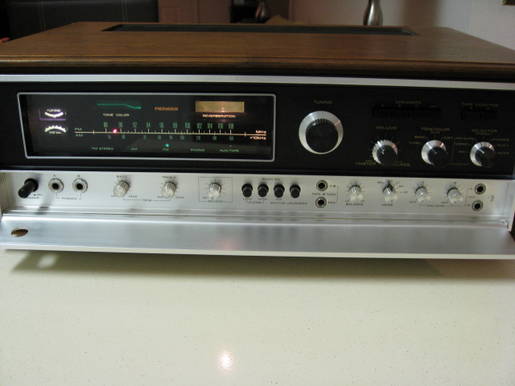
The look is proto-vintage pioneer – the SX-9000 is a generation before the venerated ‘blue dial’ or ‘silver face’ pioneers, and has more bakelite plastic buttons than later units. but the knobs are heavy and thickly damped, the glowing yellow radio dial is deep set behind the glass, and secondary tone controls are hidden behind a hinged aluminum door. How cool!

Image

The sound was awesome – vintage all the way. While it first impressed with a booming bass and strong mids, there is plenty of treble and with the right speakers it can image very well. I had it hooked up to a number of the vintage Pioneers, and they seemed to match well – the Pioneer CS line in my mind promise more bass than they deliver with their massive woofers, and the bass-prominent SX-9000 perhaps was designed to compensate. 

Another cool feature was the built-in reverb – a spring reverb system is built into the receiver, ready to add ‘depth’ to any music. My read is that this was to add to any voiceover or recordings made through one of the two mic inputs. 

One feature I used more than others was the ‘tone color’ selector – in addition to bass and treble knobs, there was a selector switch for four automatic EQ settings – flat, soft (lower treble), bass (obvious) and ‘vibrant (jack treble and bass). Switching the tone color would change the output shape in a little lighted window next to the reverb lamp – which made its own psycheldelic shape depending on how much reverb was dialed in. 

I was very happy with this receiver and it did top duty in my living room system. But the itch to keep exploring got too great and I sold it on, happily enough to another Army vet who had bought a similar one while on duty outside of Saigon. That seemed appropriate to me. 
 

Estate Sale Archaeology: JVC 5331K

•November 16, 2012 • 3 Comments

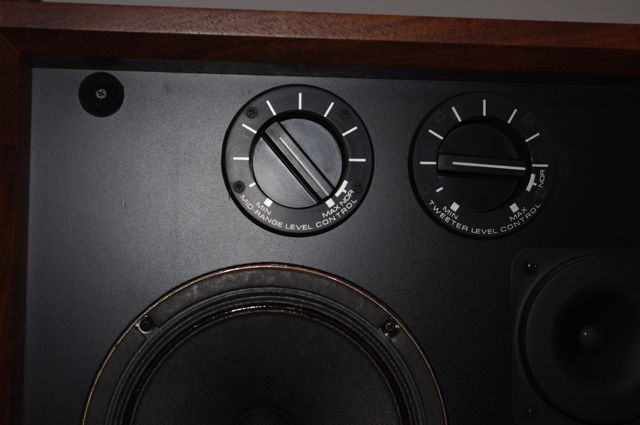
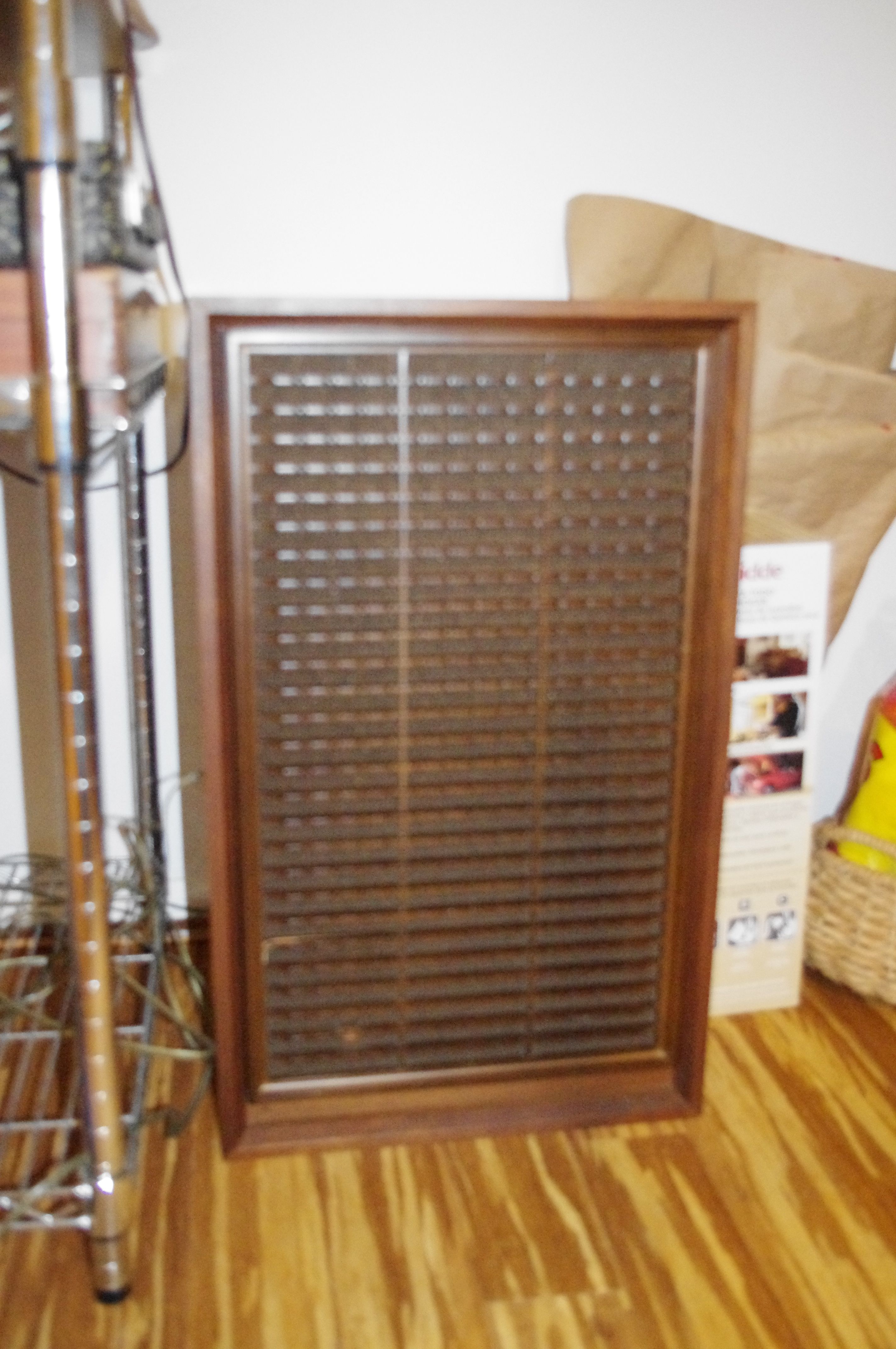
On a rainy Friday in the fall my son and I were headed back from the grocery store when I passed a sign for an estate sale in our neighborhood. Estate sales are great for vintage stereo finds and I dashed right to the basement to see what had been pushed into a corner and forgotten by the former owners.   Sure enough, I found this pair of strange floor speakers staked up in a corner. They were large, heavy and dusty – measuing 14/24/10, and weighing 40lb apiece easily. While intact inside, the grilles had a couple of bumps and there were just a few scrapes on the thick walnut veneer. I walked out with them for $40. Getting home, I took a closer look and hooked them up to my new Pioneer SX-9000 for testing. I of course pulled the grilles off for a proper test. The 5331k was a four-way speaker, with a 12″ woofer, 4″ midrange, tweeter and horn. They had two mid and high range adjustment dials on the face, which were beautifully damped. Rated for 80 watts, they could really crank. They had a nice vintage sound – warm, with balance, and surprisingly good bass.   Their most interesting feature was the special woofer – It was a pressed paper or pulp type, with cone-shaped baffles affixed to the woofer around the circumference. I couldn’t find much information online about these speakers online, or on their strange woofers- from what I’ve been able to gather the rare woofer design dates from pre-WW2 RCA development. The technology must have been transferred from RCA to JVC after the war. I loved having these speakers around. The cabinets polished up beautifully and I was able to glue and repaint the wooden grilles good as new. Eventually they made their way to my basement A/V system, and then on to new happy owners.

Realistic Fun

•September 6, 2012 • Leave a Comment

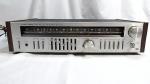
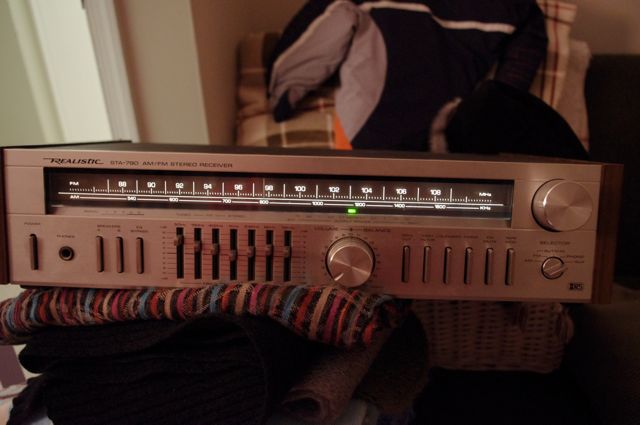
The first receiver I found was the Realistic STA-790. I spotted it at our local thrift store and picked it up on ‘half off day’ – I think the total cost was around $14. Realistic was the Radio Shack brand, and from what I’ve read back in the day much more highly regarded than Radio Shack is today – I remember my first computer was a Tandy.

This one caught my eye because of its compact and stylish design -an early 80’s model, it’s a pastiche of 70’s hi-fi trends: silver metal faceplate, a mess of like-colored knobs, switches, buttons and slides, real-wood side panels, and a greenlit tuner. In a nod to the next generation, it also had red wattage LEDs which bounced with the music, radiating out from the center of the unit. Very cool. In another nod to upcoming 80’s design, the STA -790 had a 7-band equalizer right on the face of the unit, with and EQ override button. I found it fun, though I never really fiddled with it.

This unit started right up, sounded great and never emitted so much as a pop or hiss the whole time I used it. It started as my main rig and then ended up in the basement, used as my new speaker test, and home theater stereo – I had it hooked up to my TV. Despite being only 50 watts per channel or so, I never wanted for power, even when I had two sets of speakers hooked up. For some time, I ran a set of Pioneer CS99AAs as ‘subs’ with the treble and mids turned down underneath Polk Monitor 7s. For tv watching this was plenty loud. Music, even with more hungry speakers like the Polks, could get to uncomfortable levels without distortion.

Despite being a cute and trusty workhorse, the STA-790 eventually found another home. I’ll likely never find another, at least in that condition and at that price.

Welcome

•September 3, 2012 • Leave a Comment

Hi there. I’m starting this blog as a way for me to chart what has wobbled between a hobby and an obsession for over a year now – vintage stereos and speakers. Not long after moving into our first proper house, my wife and I got the nesting bug. That sent her off in search of appropriate furniture, drapes, and kitchen essentials. And I started looking for the loudest, coolest, stereo rig I could find – years of apartment life and laptop speakers had completely warped my sense of what good music sounded like. It was time to upgrade.

After reading somewhere that vintage stereo equipment offered much more bang for the buck, I stopped by the local thrift to see what I could pick up. An hour later I walked out with an immaculate Realistic STA-790 receiver, and three speakers – two Sony SS-580 3-ways from the 1960s and one Pioneer CS-99A. I ran home and set it all up, pushing my Sharper Image minisystem out of the way.

I switched on the receiver and stood back. The dials lit up in yellow-green, and when I hit play the red LED VU meters started to jump. I was in 70s sci-fi heaven.

The Sonys backed up with half a CS-99A pair was far from ideal but the sound carried through the entire house in a way my tinny new system was absolutely incapable of recreating. I sat back and heard my music again for the first time. Wow.

Now I understood what my Dad had been after when he bought all if hi-fi gear in the early 1970s at a South Korean PX – A Pioneer SX-9000 receiver, Garrard zero-zero turntable, TEAC reel to reel, and three pair of speakers – CS-99As, CS-6As, and another bookshelf set that blew up before he left for the States.

The next day I started scouring Craigslist for more gear.