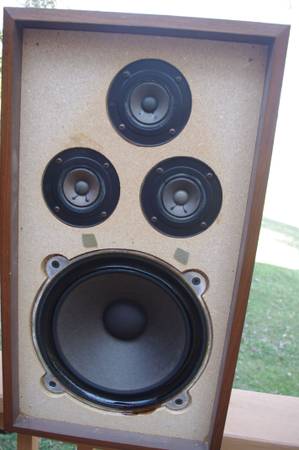
Just in: KLH Model 32 and Sony STR-7045

•October 7, 2013 • 1 Comment

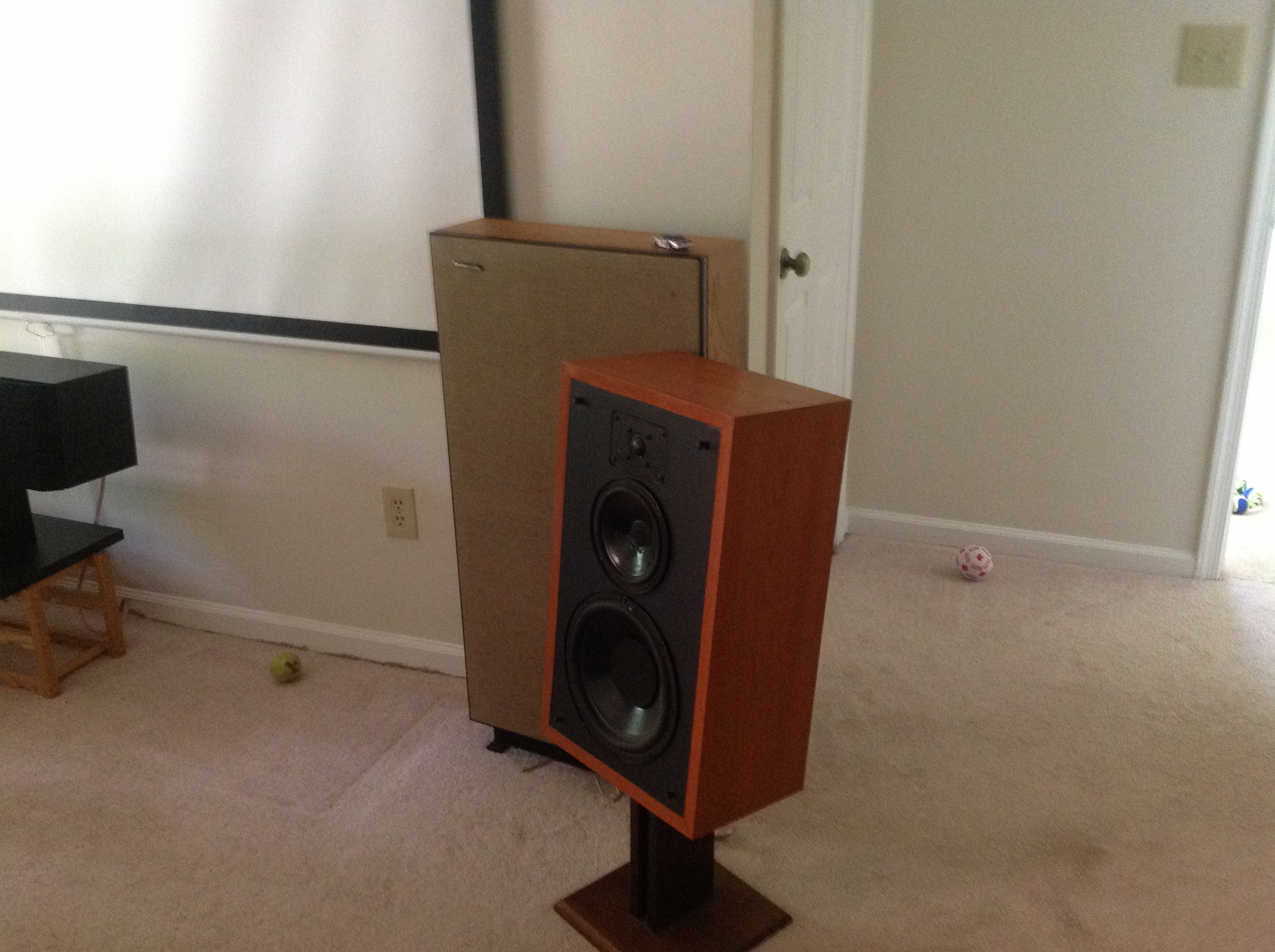
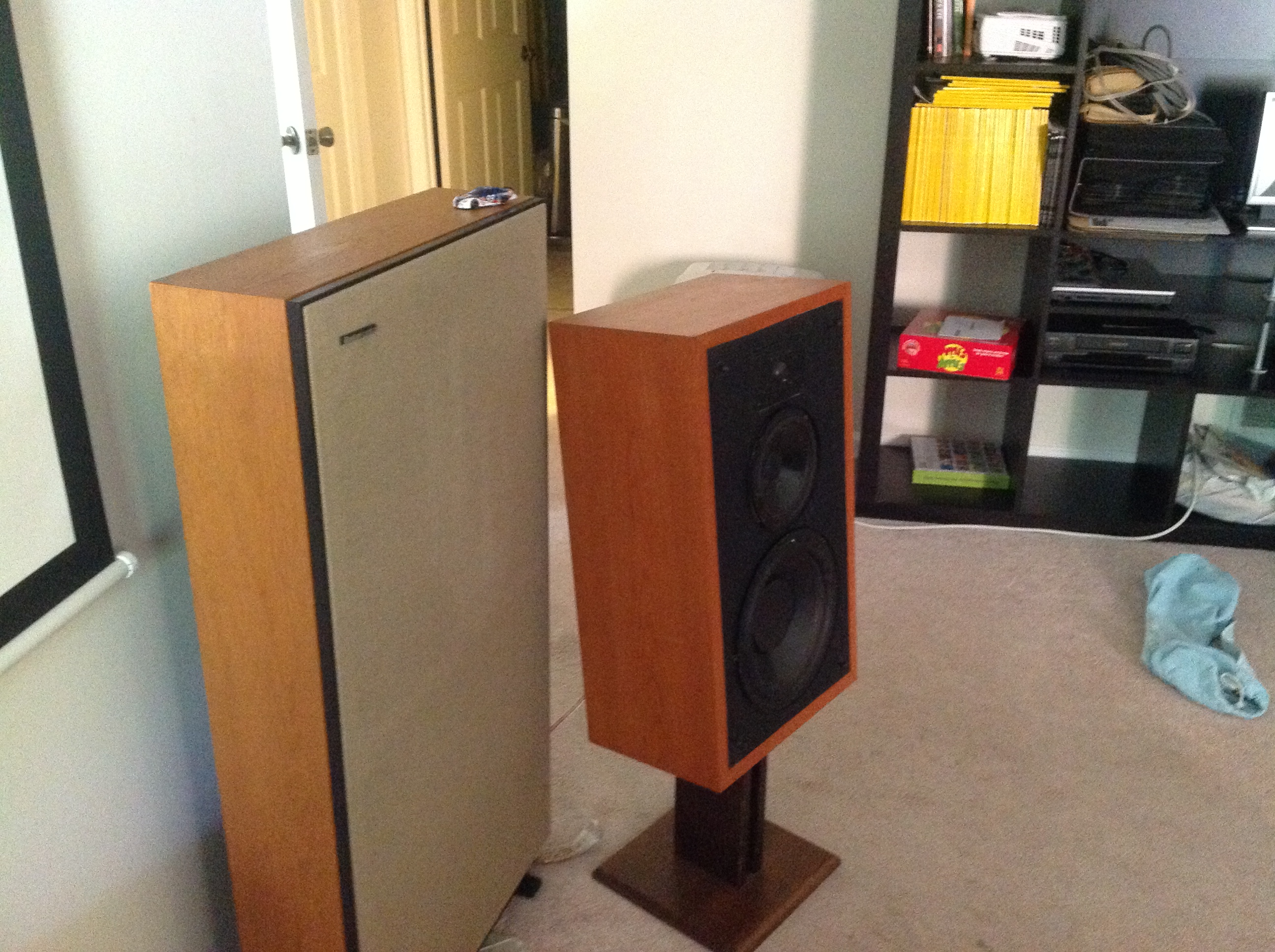
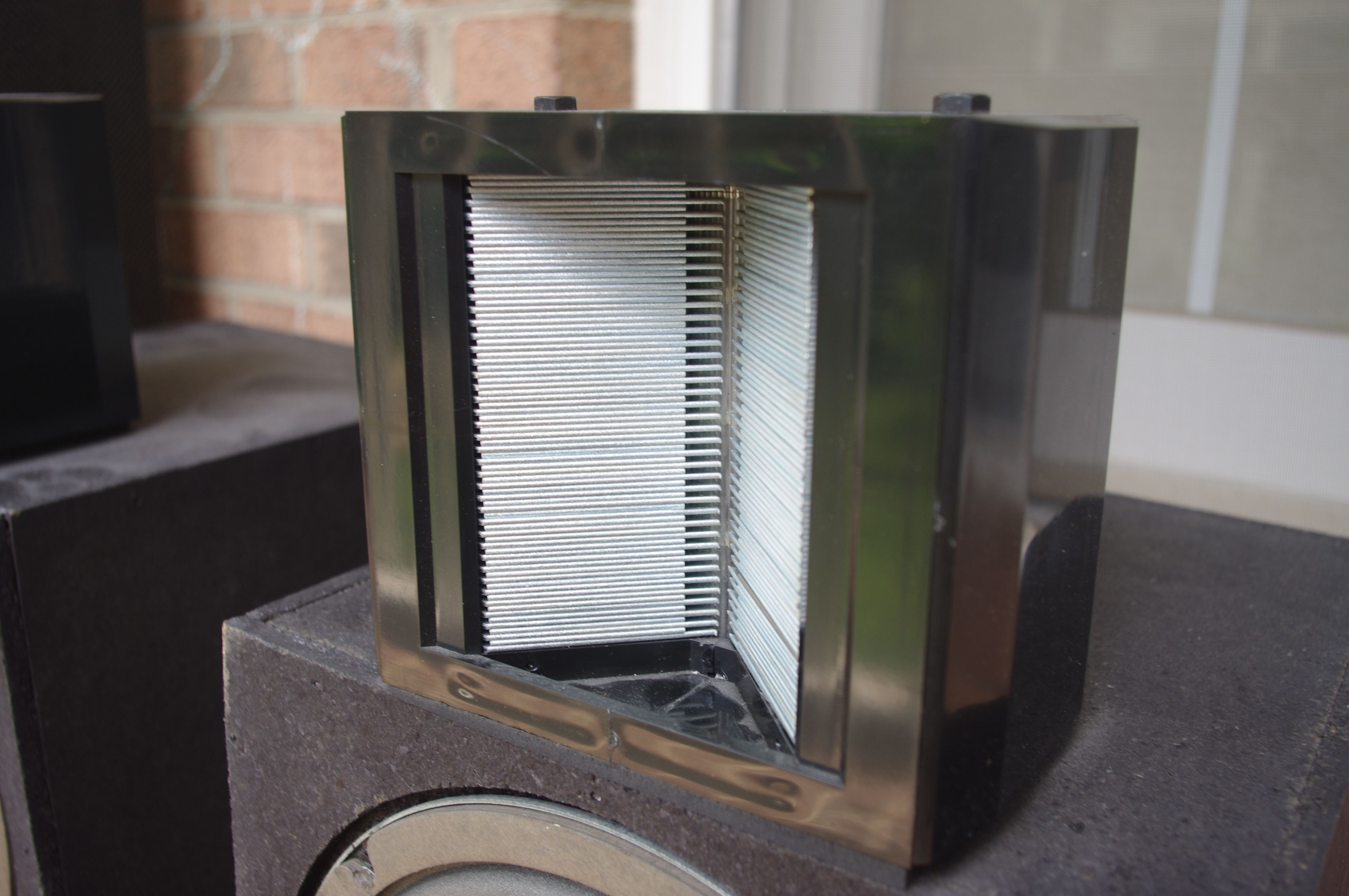
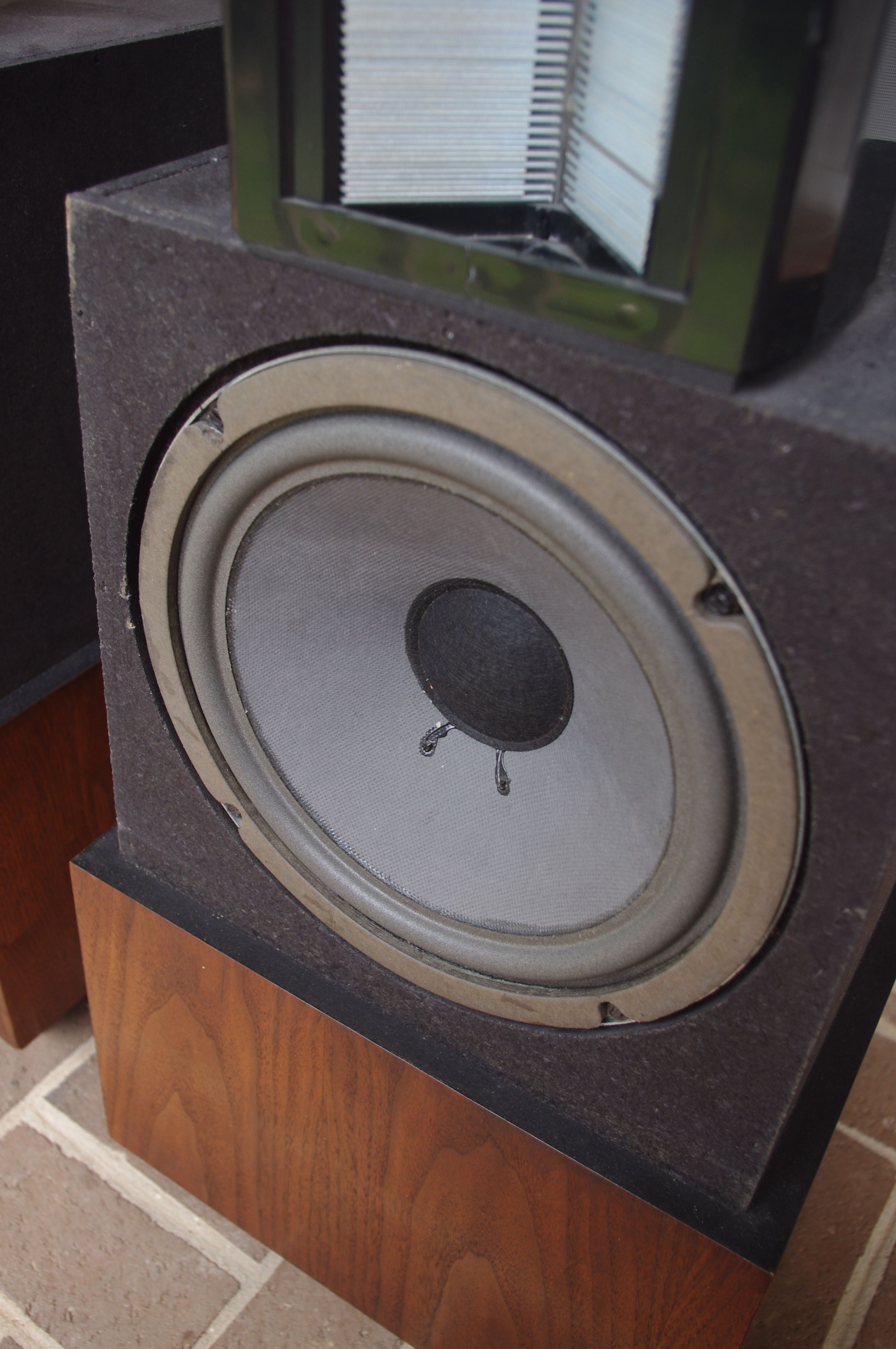
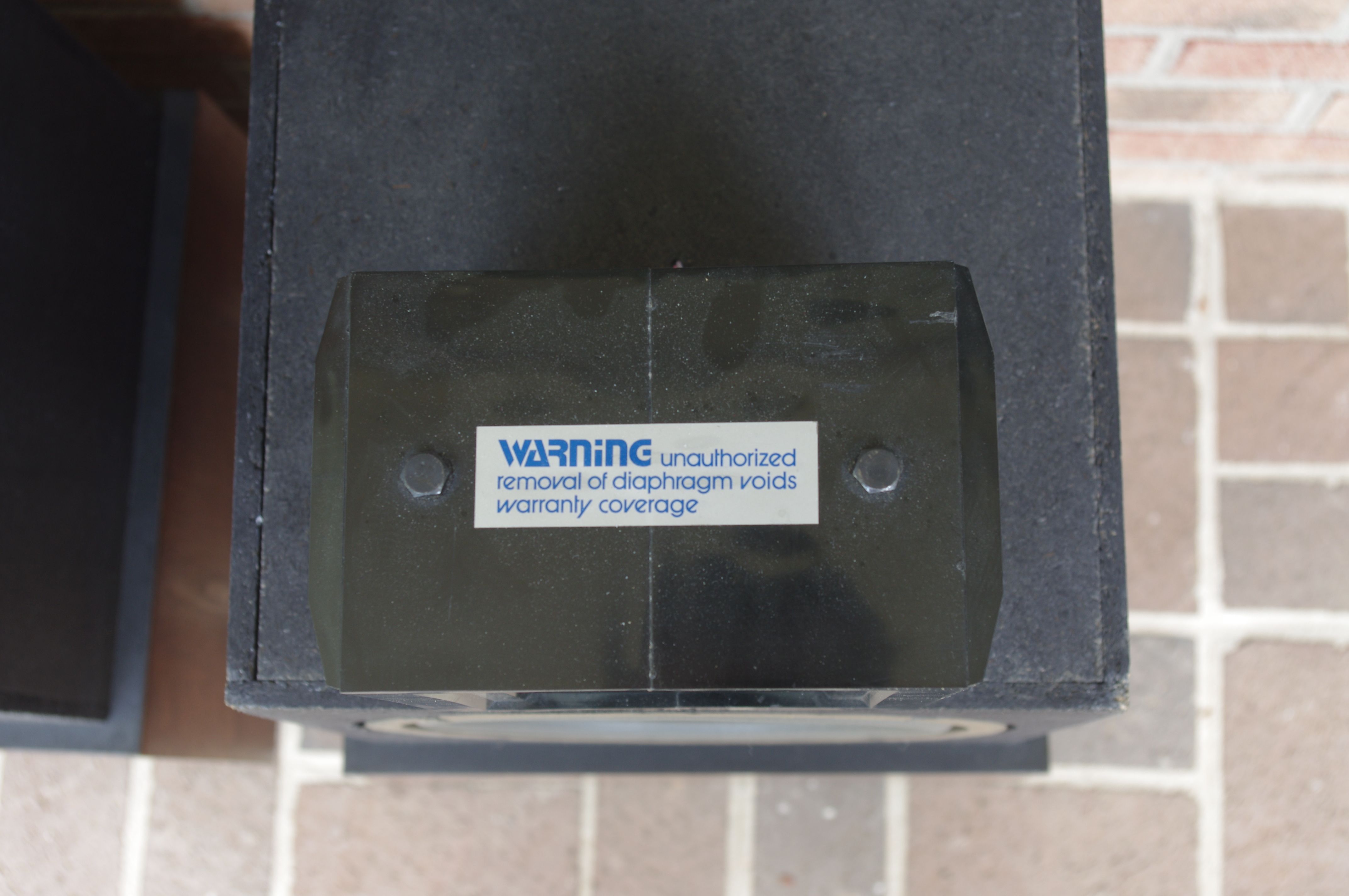
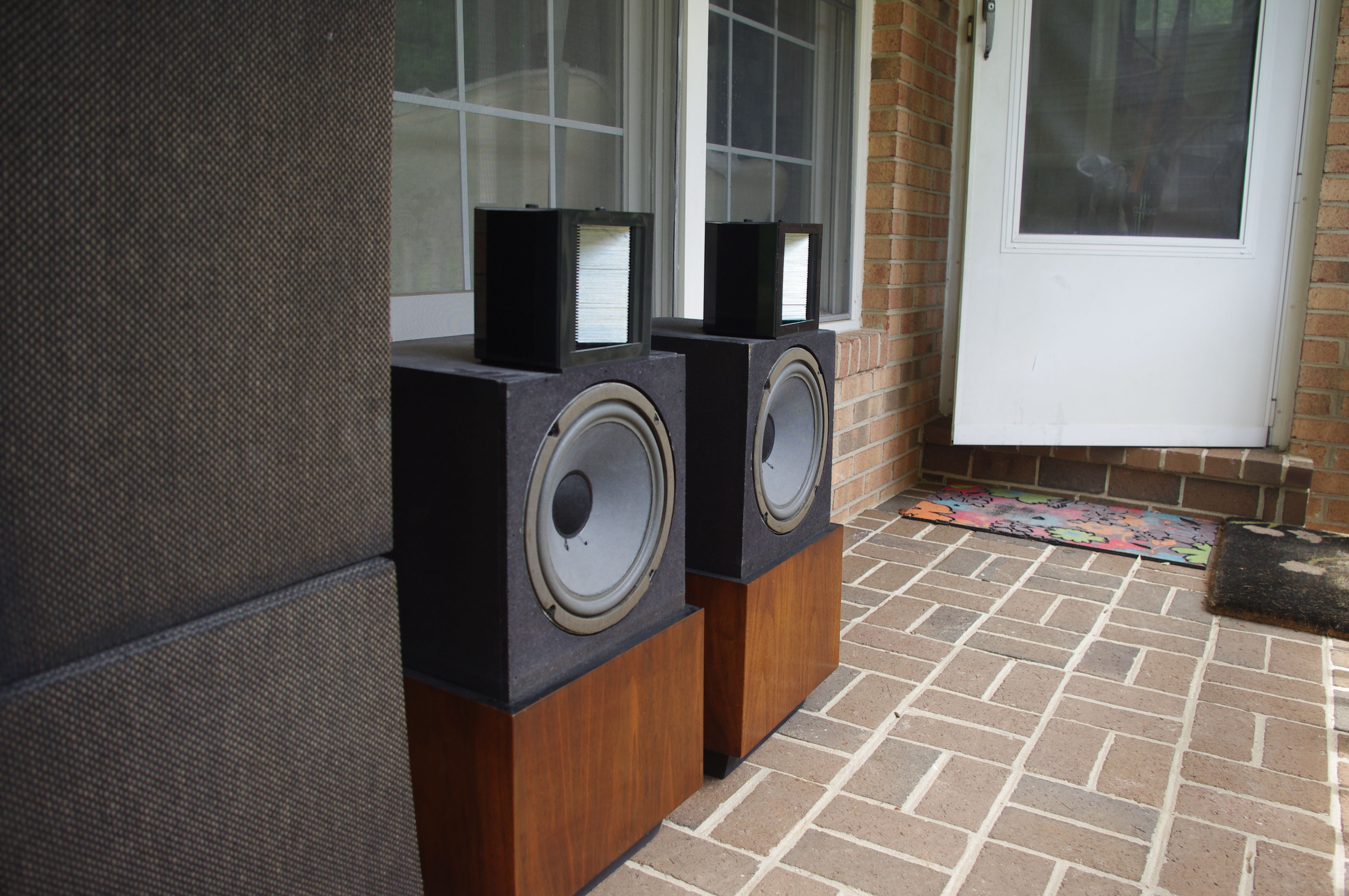
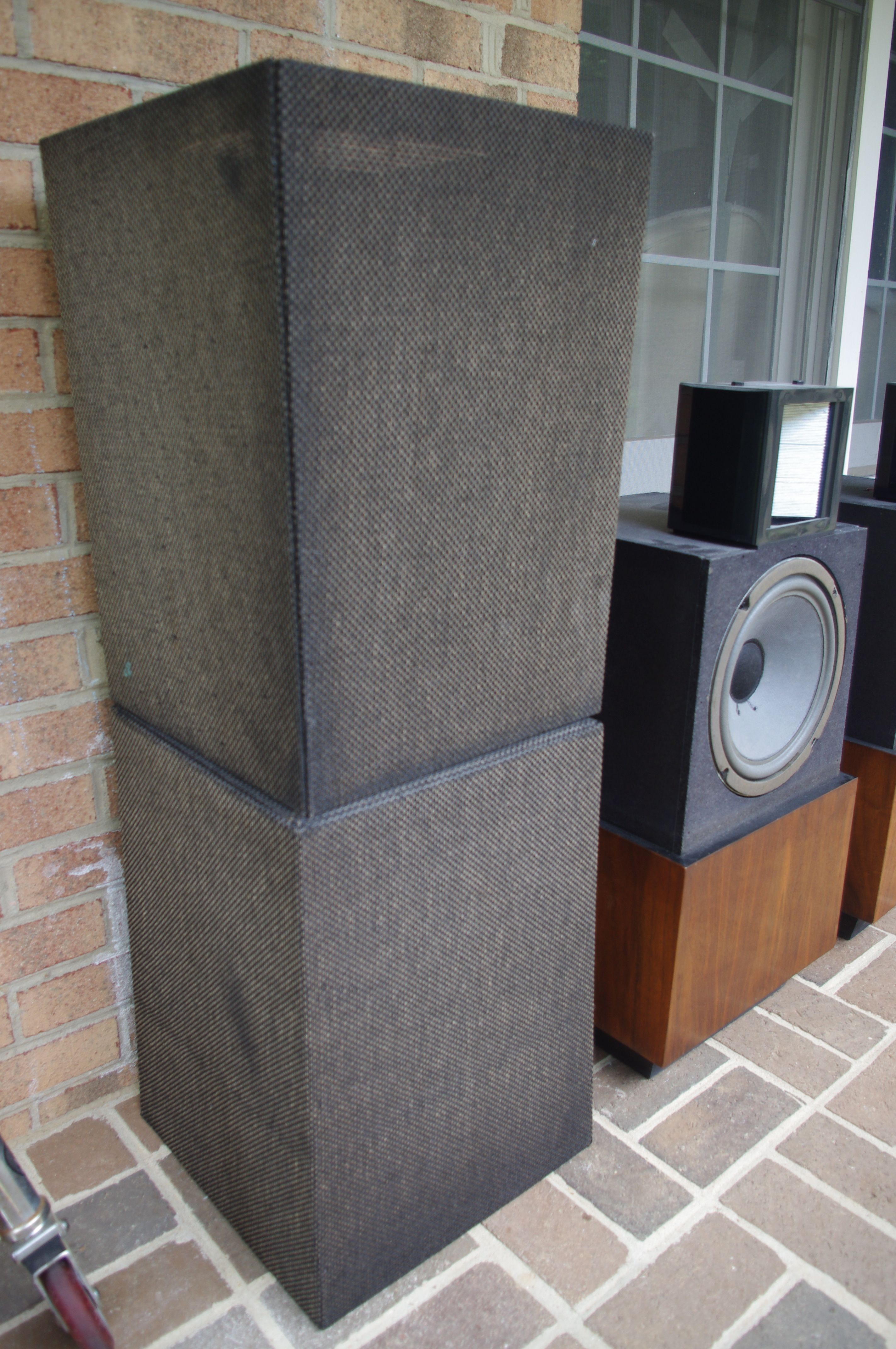
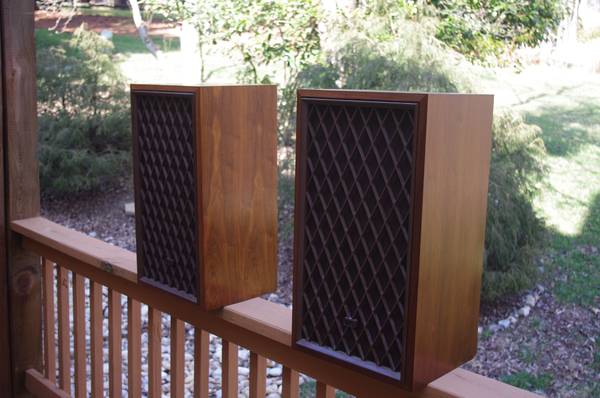
I just picked up some goodwill orphans – 3 KLH model 32 speakers and a forlorn Sony STR-7045 receiver. The speakers, in addition to only being 3, are a bit beat up. At least the thoughtful owner taped the KLH badges to the rear panels when they came unglued.

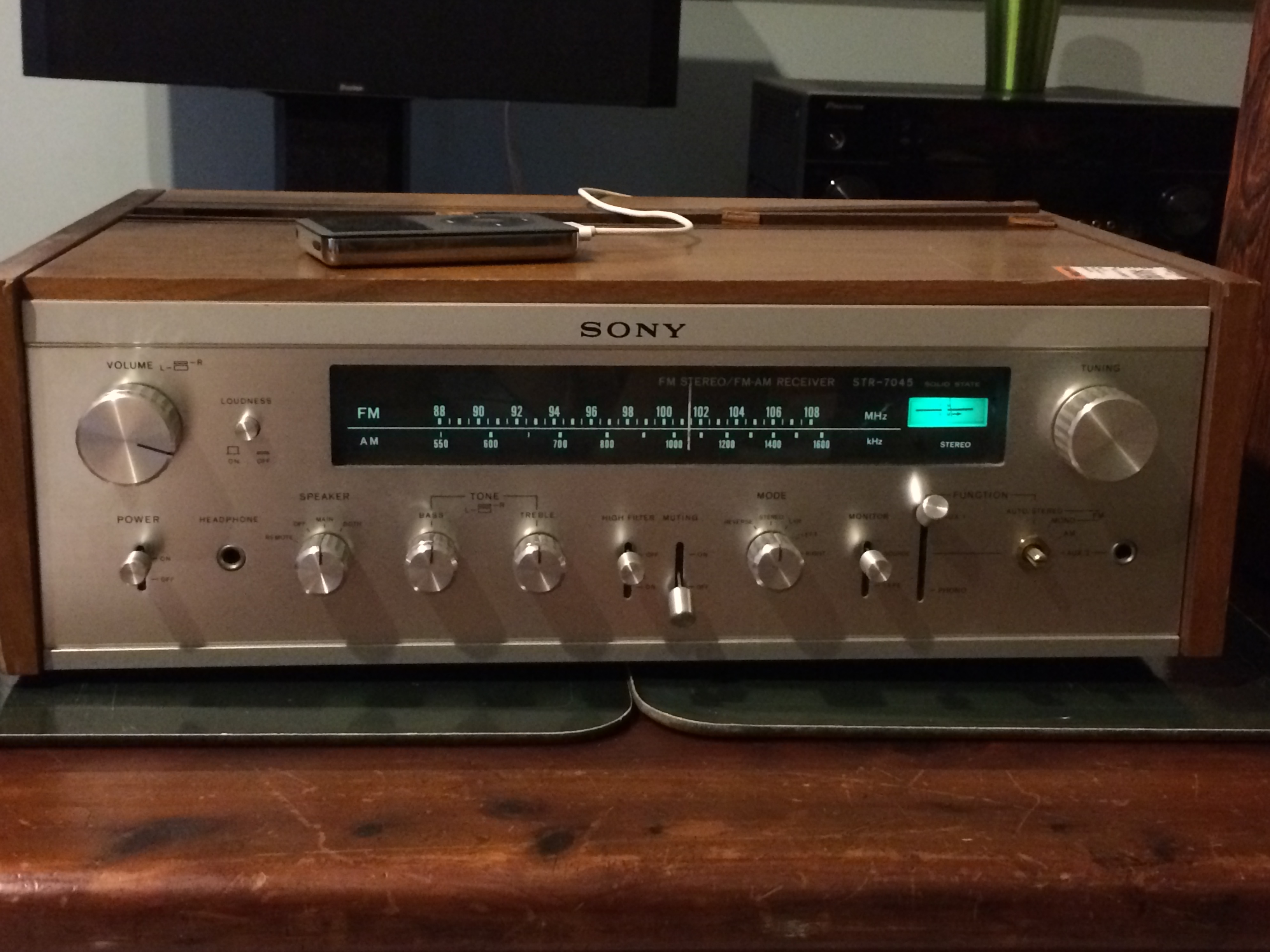
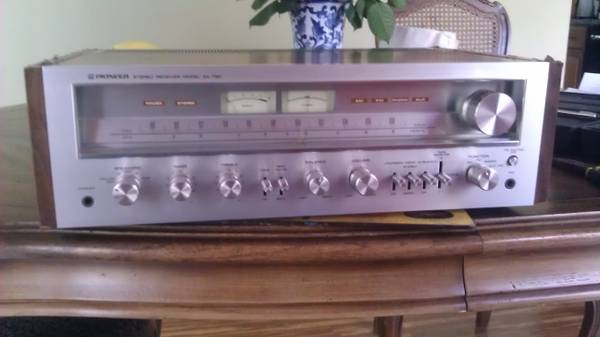
Also in is a Sony STR-7045 receiver. I had the TOTL -7065 a while ago (reviewed somewhere in this blog) so I was definitely excited to see this one. Despite being low on the model range totem pole, this is a heavy and well-built machine- I would say it’s nicer than the equivalent Pioneer SX-737, dunno about Marantz. It plays well too – hooked up to my Polk Monitor 5Bs it sounds pretty nice, and gets loud quick. It deserves a deep cleaning, and the wood case needs some restoration – some of the vent slats are broken loose. This was a problem on my 7065 too. And the function knob is missing – looking for a replacement, but eBay is a little pricey.

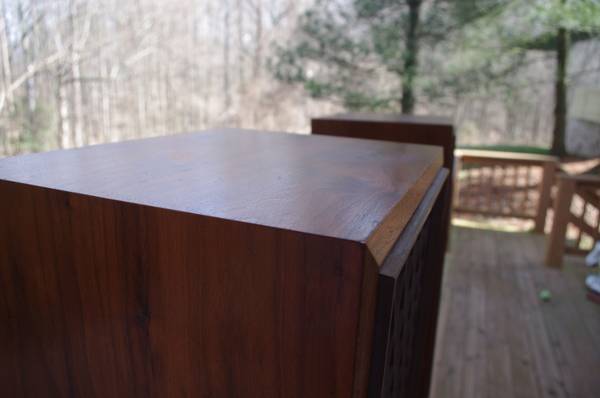
I tested the KLHs too – they do not sound great right now. Online reviews speak highly of these little guys so I’m hoping a new capacitor will cure their ills, and that I’ll be able to make them gleam with a light sanding and refinishing.

Sony STR-7045

Sony STR-7045

Sony STR-7045 playing Polk Monitor 5Bs

Sony STR-7045 playing Polk Monitor 5Bs

KLH Model 32s

KLH Model 32s

KLH Model 32

KLH Model 32

Pushing the Envelope: NAD 7240 PE

•September 27, 2013 • 32 Comments

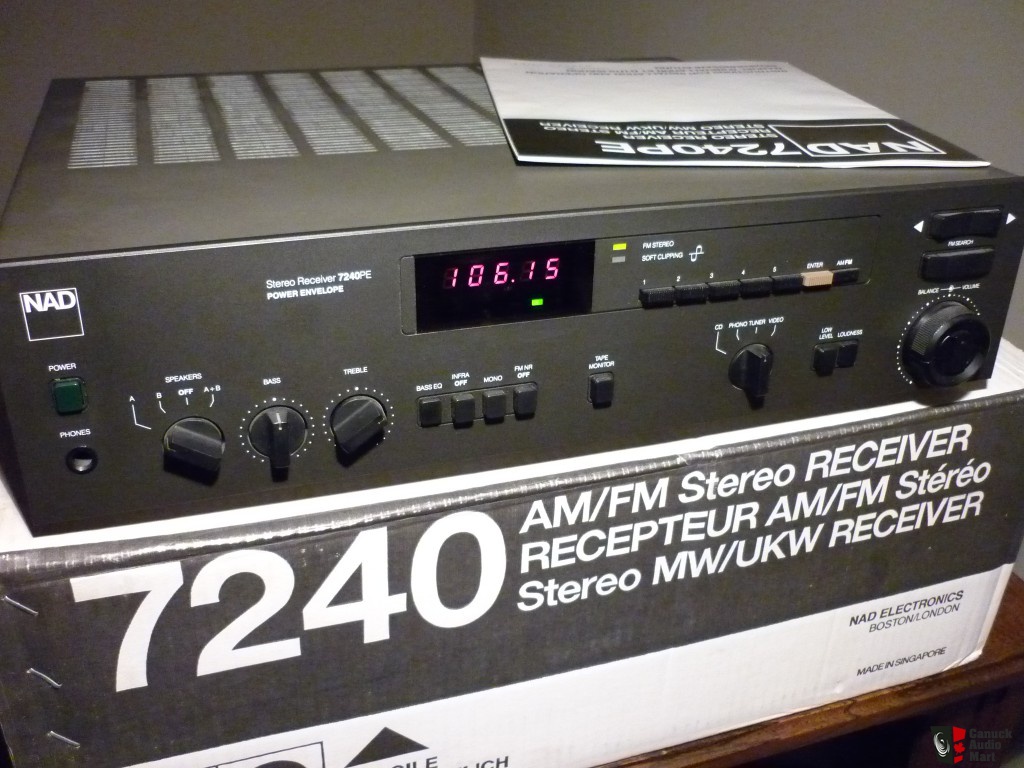
I’ve been wanting to try out a vintage NAD receiver for a long time. Based on popular reviews (check out Steve Guttenberg’s review of the NAD 3020 here ) an early-series unit looked to be too enticing to pass up.

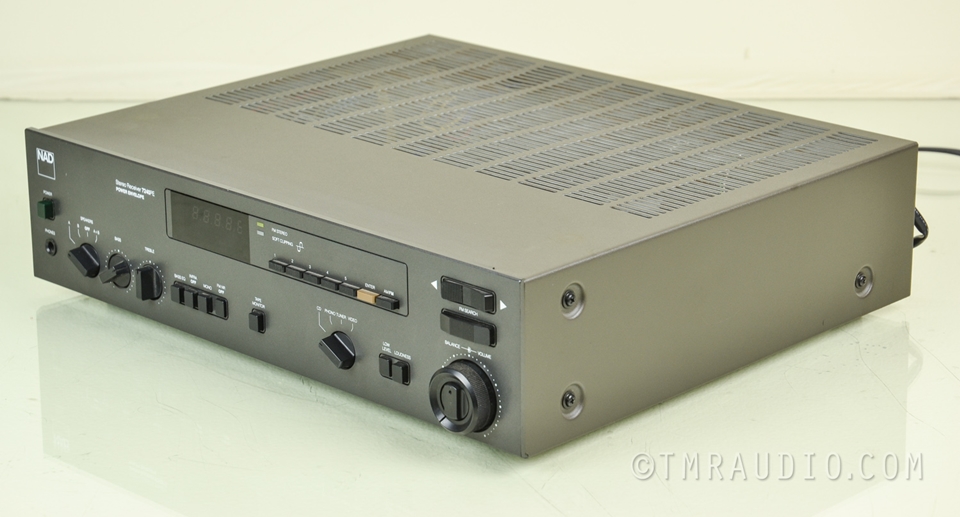
NAD 7240 PE in all its glory. Courtesy Canuck Audiomart

NAD 7240 PE in all its glory. Courtesy Canuck Audiomart

NAD (New Acoustic Dimension) was founded in England in the early 1970s with a philosophy of focusing on the sound first. Components were there to perform, not to shine. Their vision allowed for a high-end sound and lower-end prices but resulted in some dumpy looks – amps and components were uniformly greyish squat boxes with small plastic buttons popping out here and there. The aesthetic was definitely in contrast to the bombastic shiny metallic space-race instruments on display from Japanese brands of the time. But then again NAD was free to devote all of their development dollars to the sound quality of the amp, and not to machining gorgeous tuning knobs from pure ingots of aircraft-grade aluminum.

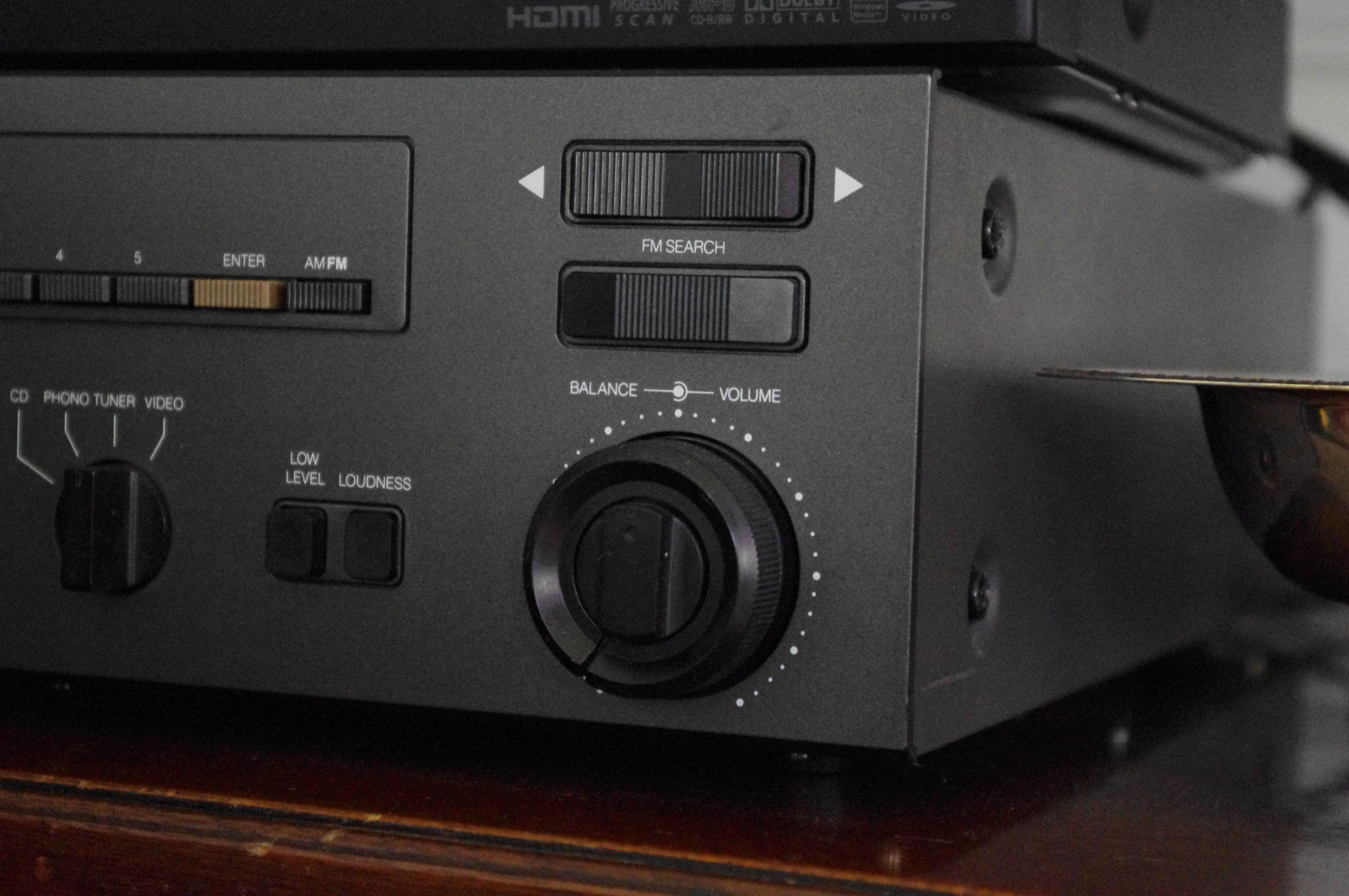
My NAD 7240PE. Note integrated volume/balance and space-age radio tuner rocker buttons.

My NAD 7240PE. Note integrated volume/balance and space-age radio tuner rocker buttons.

From early on NAD also focused on incorporating ensuring high levels of dynamic headroom in their amps, meaning that a lower-rated sustained power amp could spike to much higher wattages to handle musical transients, ensuring clean playback at top volume. It also means that when you test a NAD, you’re likely getting more power than the box advertises.

The 3020 reviewed by the Audiophiliac at the link above was advertised as pushing 20 watts per channel at 8 ohms, but could provide as much as 58 watts at 4 ohms or a bruising 72 watts at 2 ohms. First off, those are some extremely impressive numbers for any amp, much less an entry-level model. And stability as low as 2 ohm impedance is also nothing to laugh at – most modern home theater amplifiers are rated for no lower than 6 ohms, and some will start to get a little crispy while they’re at it.

It’s rare in the home audio world that a manufacturer under-states bragging-right stats like wattage, which is intriguing in and of itself. The fact that folks uniformly raved about the sound made it even harder to resist.

So I found one to call my own.

It wasn’t after a long search, however. NADs are pursued by a small following of people in the know – when a NAD comes up for sale locally on CL or the like it’s either priced very high (cognoscenti and sentimental value push up asking prices), or it’s priced bargain-basement and snapped up posthaste. I had to focus on the latter category since I didn’t have the free cash to invest in a top-order vintage NAD unit, so I kept my eyes peeled.

I eventually found a single-owner NAD 7240 PE receiver locally and took it home. It had spent its life pushing a pair of Time Frame TF350 speakers (almost took those home too!) and hadn’t been used in 5 or so years at all.

My 7240 is a later-generation unit in the NAD line, one generation or two after the legendary 3020 series. PE stands for Power Envelope, which was the marketing moniker of the time for NAD’s high-current amp system. The 7240 was rated at a 40 watts per channel of steady power, but its +6 dB of dynamic headroom provided up to 160 watts/channel at 8 ohms, and up to 200 watts per channel at 2 or 4 ohms for short bursts.

What? 200 watts per channel? Out of this little thing? That puts my monster Pioneer SX1250 to shame!

So bringing it home, I simply had to put it to a test with my newly-restored SX-1250.

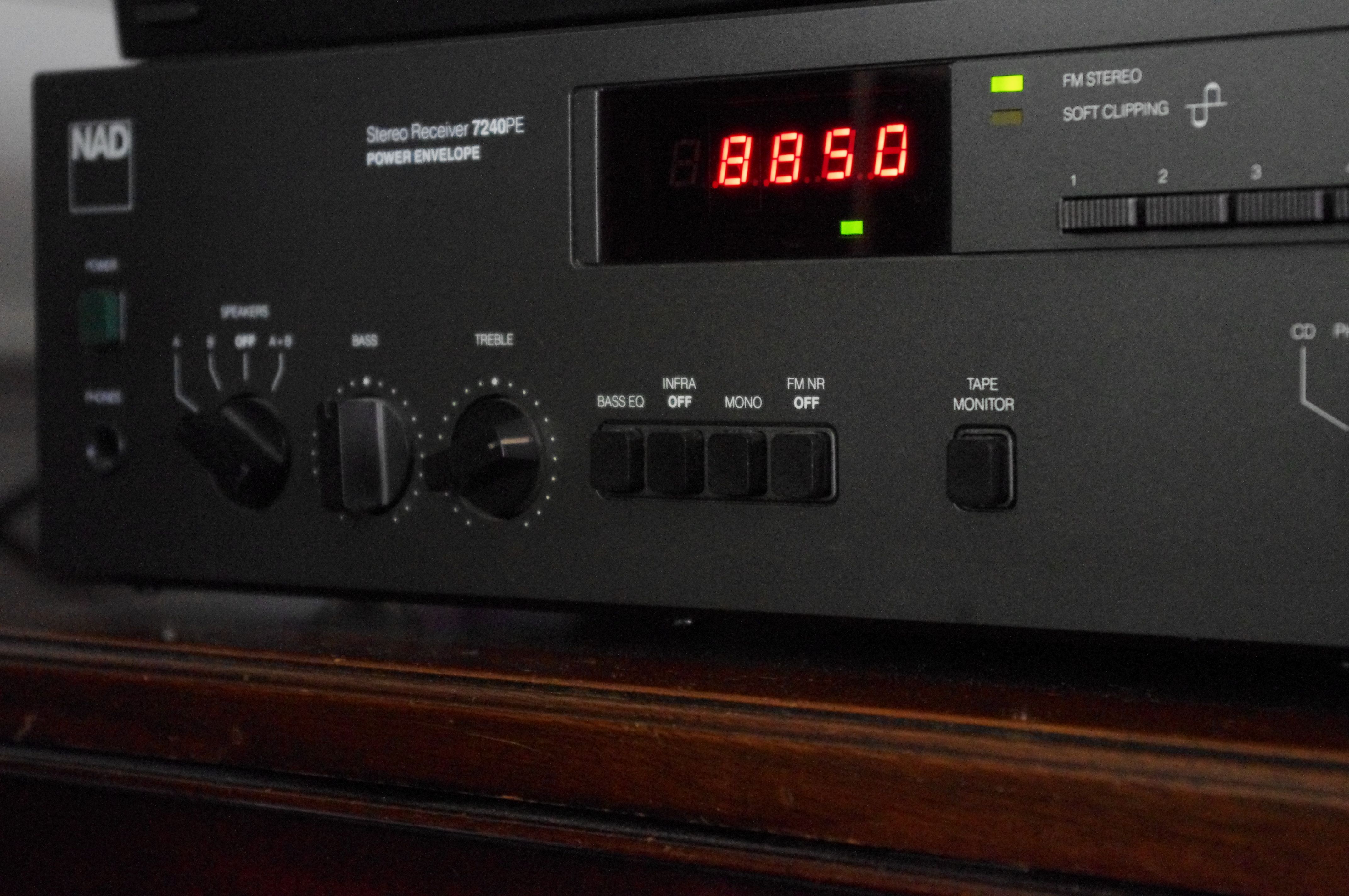
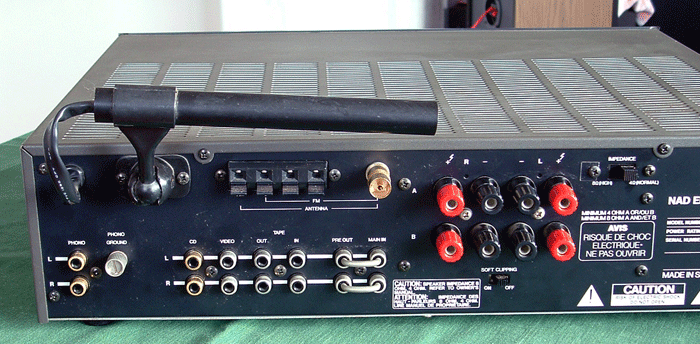
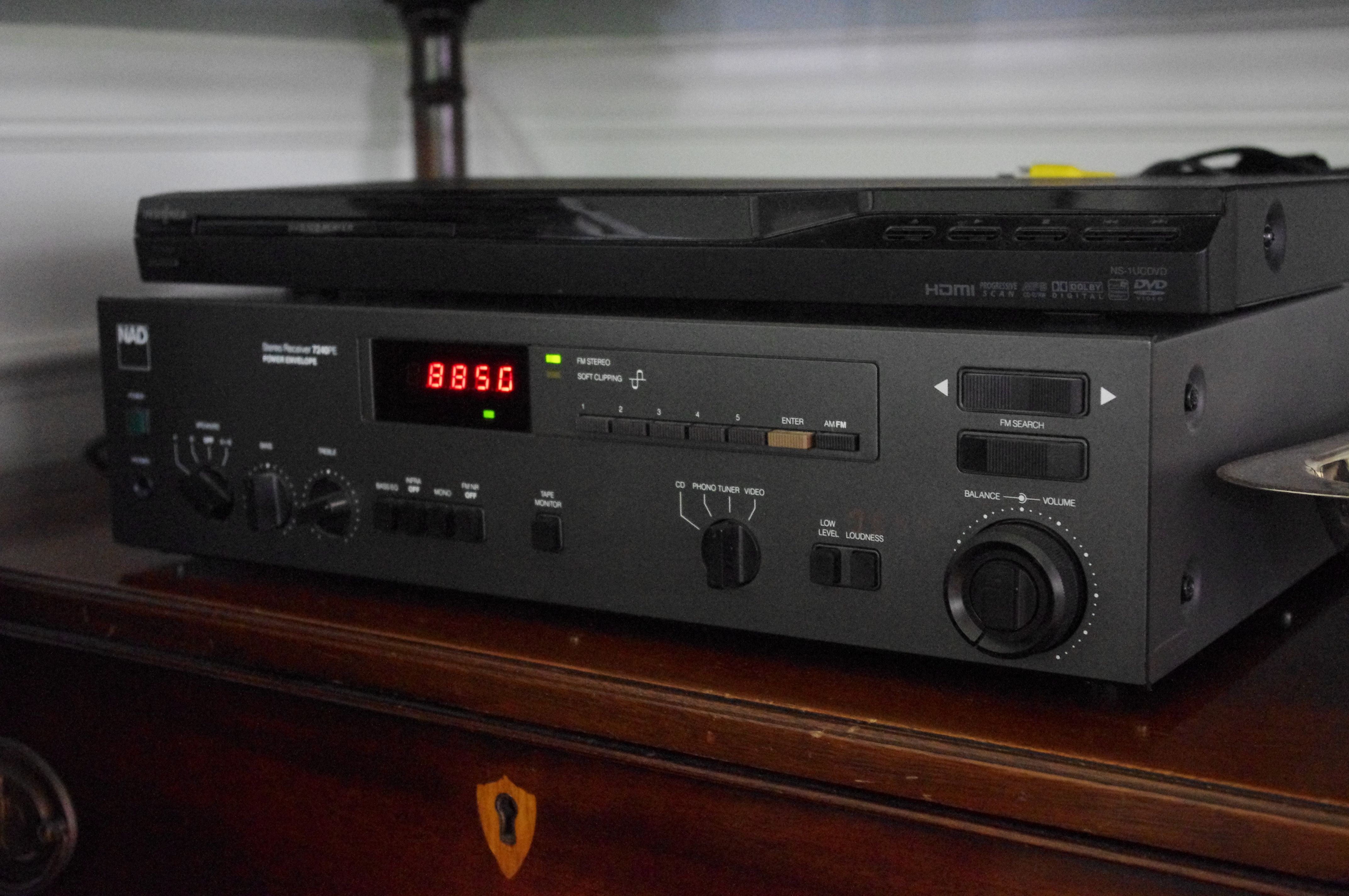
First came the visual inspection. The 7240 is typical of the NAD family – grey metal box with black plastic buttons. As this is a receiver, preamp, amp, and radio tuner are all included in the package, which is a tidy 16 x 4 x 15 inches. There’s a small red LCD display which notes the radio station, even when you’re switched to CD, Phono, or Video. There’s an integrated volume and balance dial on the right (which has a great damped turning feel), as well as some bass and treble knobs and sound contour controls. I was happy to see a loudness button, which I use ,and amused to see the soft clipping and Bass EQ buttons, which I don’t.  Around back you have the usual RCA inputs, 5-way binding posts, as well as a switch to move amplifier impedance from 8 ohms to 2-6 ohms, based on speakers. I kept it off the 8ohm slot since I run a lot of larger speakers with lower impedance.

NAD 7240PE. Displaying radio station all the time on red LCD.

NAD 7240PE. Displaying radio station all the time on red LCD.

Rear of NAD 7240PE. Not much to see here, folks.

Rear of NAD 7240PE. Not much to see here, folks.

I hit the green power switch on the left of the faceplate and waited for everything to warm up. I did the same with the big Pioneer.

I then tested both receivers with my Boston Acoustic A200s and Klipsch KG4s.

Nice!!

The NAD inhabits two worlds effortlessly. It manages to sound exacting and clear up into the highest ranges just like modern equipment does but brings in some emotion and lushness to the music similar to a vintage unit. Just like my Pioneer VSX-820 there are no top-end losses of detail, which is something that is harder to say with other vintage equipment. The spread and balance between treble and midrange was good – one was not overpowering of the other. In comparison to my SX-1250, the midrange was not as honey-sweet and didn’t ring with the same round tones. It wasn’t as if anything was missing but there is a sonic difference between the massive Pioneer and the NAD. I would more call it a contrast in tonal philosophy, which allows both amps to go home happy.

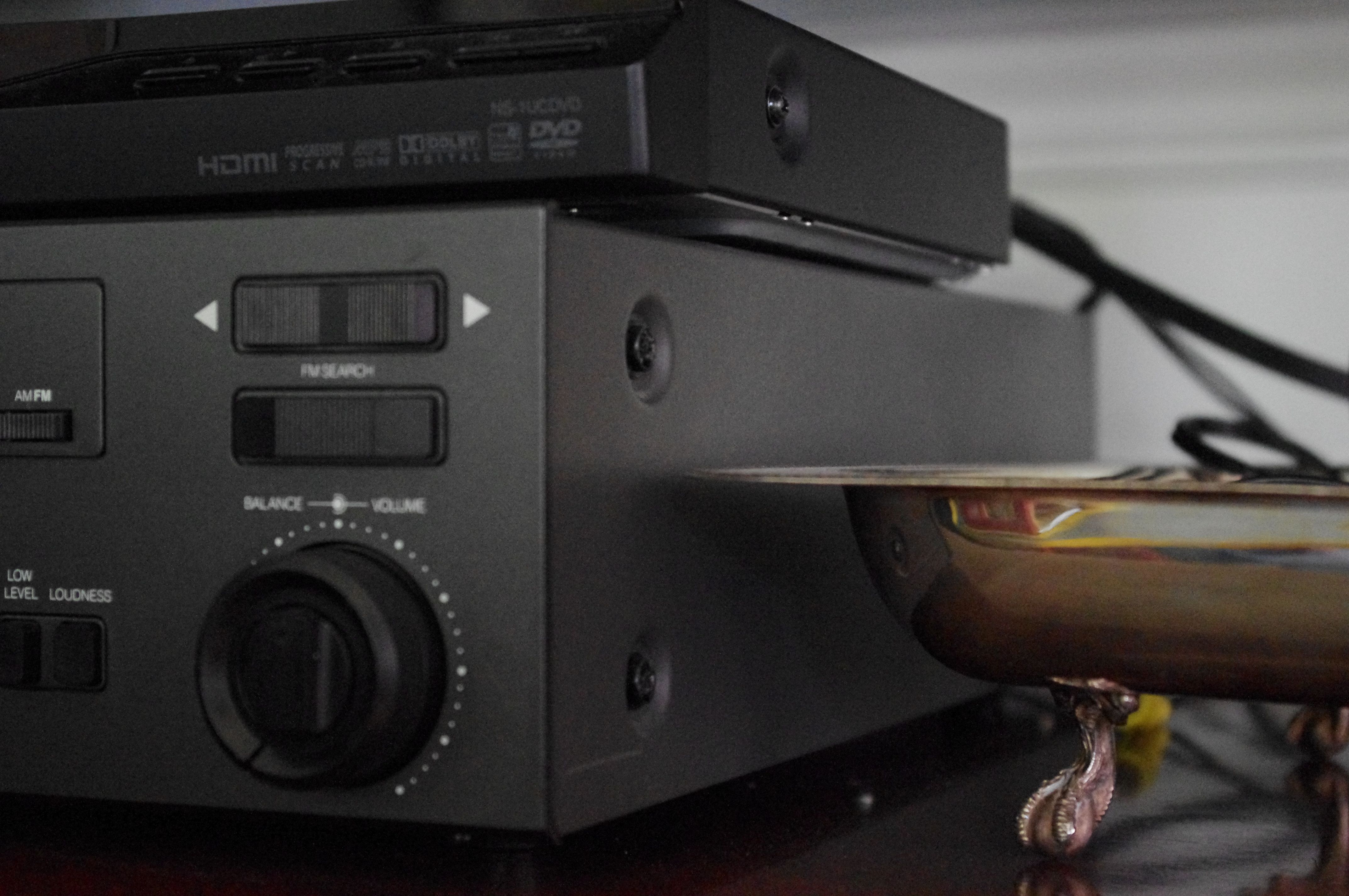
NAD 7240 PE with Insigna DVD player. Low profile, good sound.

NAD 7240 PE with Insigna DVD player. Low profile, good sound.

On the low end I was very impressed. Bass was massive. This thing felt like a diesel on idle to me – you knew that there was plenty of grunt just waiting for you there if you wanted to push your foot down a little more. That said bass was controlled and kept in check with the upper reaches. No booming or exaggerated low end like I’d heard on some cheaper Pioneer and Sansui receivers.  Very very nice. Just as Pirelli advertised – power with control.

In contrast, my SX-1250 was a little less detailed at the higher reaches but much more golden in the mid tones. Bass was comparable, imaging not as good as with the NAD. But definitely a more vintage vibe.

IMGP3146

I note that this test was with material from an iPod Classic. The songs are high bitrate but I’m learning that the SX-1250 is sensitive to input material and doesn’t seem to really shine with the iPod. I’m interested to try it more with a CD player when I’ve got my basement listening area unpacked – with my Yamaha P-500 phonograph the Pioneer is magical. I guess that also means I’ll have to haul the NAD back down for a test of its phono stage too.

So I really really like the NAD. It is deceptively powerful – there are buckets of reserve waiting to be used. Sound quality is exceptional, and reflects its transitional place in my mental pantheon of vintage receivers  – the 7240 is clear and can be clinical in a digital era sort of way but it doesn’t lose the emotion and warmth of the vintage set in the process.

NAD 7240 PE even more flattering in this light. Courtesy eBay

NAD 7240 PE even more flattering in this light. Courtesy eBay

Pitting it up against my newly-returned SX-1250 I honestly wondered whether I needed both. The NAD is far too nice sounding for the function I currently have it performing as living room ambiance generator paired with my KG4s. That said, tuned into classical or jazz and with the KG4s properly placed from the wall, the NAD’s powerful and controlled bass mitigates some of the boominess out of the KG4s’ rear passive radiators and leaves clean tones down to 40hz, perfect for some of the upright bass and lower orchestral notes that carry so well across my long living room.  And Led Zeppelin sounds awesome too.

If you have the means I definitely recommending picking up a NAD. For their performance they are an amazing value. They are relatively easy to come by and pretty durable – units of more recent vintage have their share of weak spots in the components but for the most part these can be mitigated with some re-soldering and minor repairs – just do your internet homework. And if you’re into going new, NAD’s current designs continue to bring top-notch sound with entry-level audiophile pricing. You really can’t go wrong.

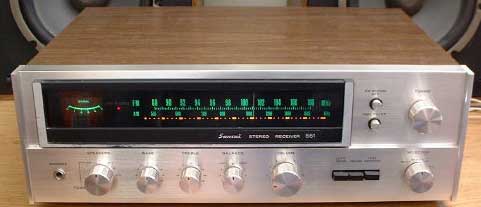
Sansui 551

•September 27, 2013 • Leave a Comment
Sansui 551 ad. Courtesy of Classicaudio.com

Sansui 551 ad. Courtesy of Classicaudio.com


Boy, did I like this little guy.

It came to live with me from a good friend and fellow audiophile who had enough gear in his stable and wasn’t using this one. He was also suspicious that perhaps the amp had blown due to some overly-thirsty speakers. I took it home and decided to play around and see what I could find.

I plugged it in to my workshop and set it up with a pair of Realistic Optimus 6B speakers, and then my Design Acoustic PS-10s.

Appearance-wise, this receiver fit into the early-70s design aesthetic. Knobs along the bottom and a radio dial that terminated 2/3 of the way along the top of the receiver, not reaching all the way across the top of the unit like subsequent offerings later in the decade. Pioneer and Sherwood did it this way too in the late 1960s and early 70s. This is also a compact piece of machinery – narrow (16″)  but heavy (19lb) for its size and meager 16 watts per channel.

There was nothing wrong with this amp. Nothing at all.

551 from the front. Classy. Not mine - photo courtesy Canuck Audiomart.

551 from the front. Classy. Not mine – photo courtesy Canuck Audiomart.

I’ve demoed only a small number of Sansui amps. Really just this one and the massive quadraphonic receiver I’ve written about before. Both were very very liquid and sweet-sounding units. To me, sweet means detailed but not clinical. Maybe another way of putting that would be a healthy midrange and maybe a bit rounded off at the corners. The QR-4500 was almost goopy sweet, but this little 551 was just right.

There was plenty of power to drive the semi-hungry Optimus 6Bs to good volume, with sufficient bass. Detail on the high end was very nice and never shrill. For only having about 16 watts per channel advertised, I never sensed any clipping or distortion indicating I was overdriving them, so they performed admirably.

A bonus was great FM radio reception. even in my basement up against the foundation wall I got good catch on the radio stations.

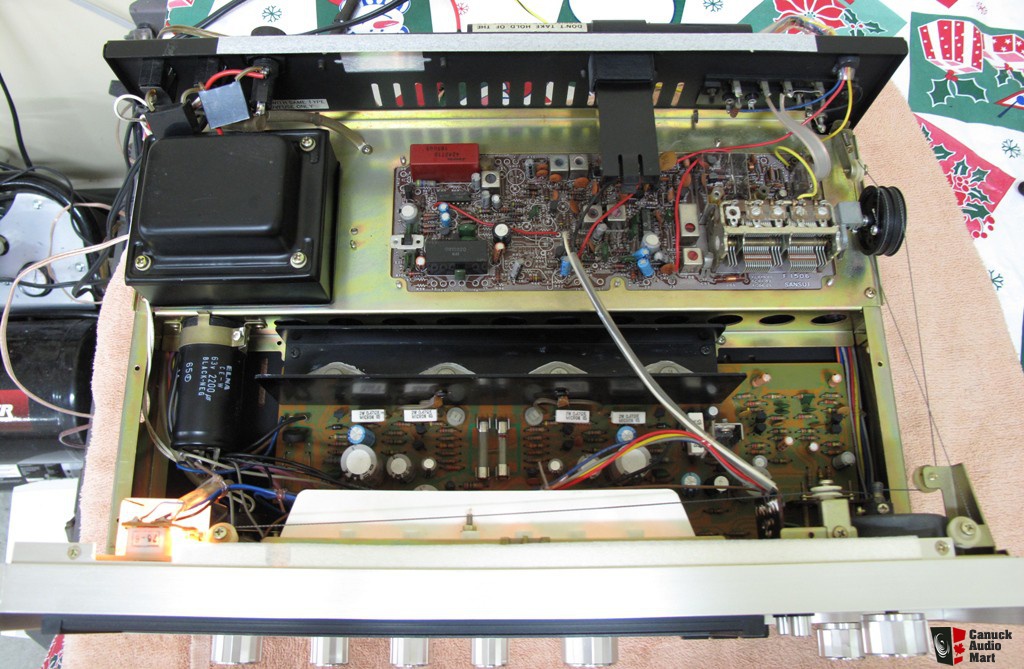
551 on the inside. Simple. Not a lot of big pieces needed to push 16 watts per channel. Also from Canuck Audio Mart.

551 on the inside. Simple. Not a lot of big pieces needed to push 16 watts per channel. Also from Canuck Audio Mart.

People really rave about this early 1970s series of Sansui amps, with a lion’s share of the enconium going to the top of the line 881 model. But I wouldn’t sell the more basic units like my 551 short. In good shape, these are very fun little amps, and will provide a lot of enjoyment for very little money.

Little microchip that could: Lepai 2020+

•September 5, 2013 • Leave a Comment
Lepai 2020+ in action

Lepai 2020+ in action

I’m constantly reminded that sensory inputs like sight, sound, and touch can’t be separated. It’s why the aroma of fresh pie is integral from the taste, why you anticipate how a leather seat sounds when you fall into it, why rock concerts have light shows. The main sensory effects are amplified by enriching the experience with other senses.

I think that’s part of the reason why I value the aesthetic so much in my obsession with hi-fi. Performance is key but presentation is almost as important. I’ll guarantee ugly speakers sit in the showroom long after all the pretty boxes are sold.

And this blog is called ‘silver face stereo’ for a reason – personally, I think the style and aesthetic of the hi-fi world back when things were supposed to be seen and heard is hugely important. I think it’s a tragedy that in recent decades it seems that most of the mainstream home entertainment design has gone out the window, replaced by black plastic boxes.

Good design can be participatory and bring you in to the process. Even if you’re never going to use them all, admiring or playing with the myriad dials on a classic receiver makes you part of bringing the recording alive. So does queuing up a track on a turntable. You are helping to reproduce this experience and therefore make it your own. Interestingly enough for me, contemporary digital design is exacerbating this tendency:  iPod, iPhones or Android phones, with design and interface staging that is intended to disappear in use, cannot oby definition make you a participant in this important way. The irony of a digital interface that seems seamless and transparent is that it connects you less with the experience, not more. You don’t have to work for it.

Lepai 2020+ with iPod Classic

Lepai 2020+ with iPod Classic

So here we are then with the Lepai 2020+. A minimally-designed shiny plastic box the size of a couple of decks of playing cards. When I say it is minimally-designed, I don’t mean in the Bauhaus style – I mean minimal thought was put into making it look good. To my eye, it’s not far removed in design from the car amplifiers my friends stuffed into the trunks of their ’82 Corollas in high school – light metal casing, shallow ribbing over the tops and sides, bright LED light of some sort announcing its presence. It does not look expensive at all.  But since it’s so small, you can hide it, so maybe its looks aren’t that important. And really, for $20 you’d better hope they’re spending money on the sound quality.

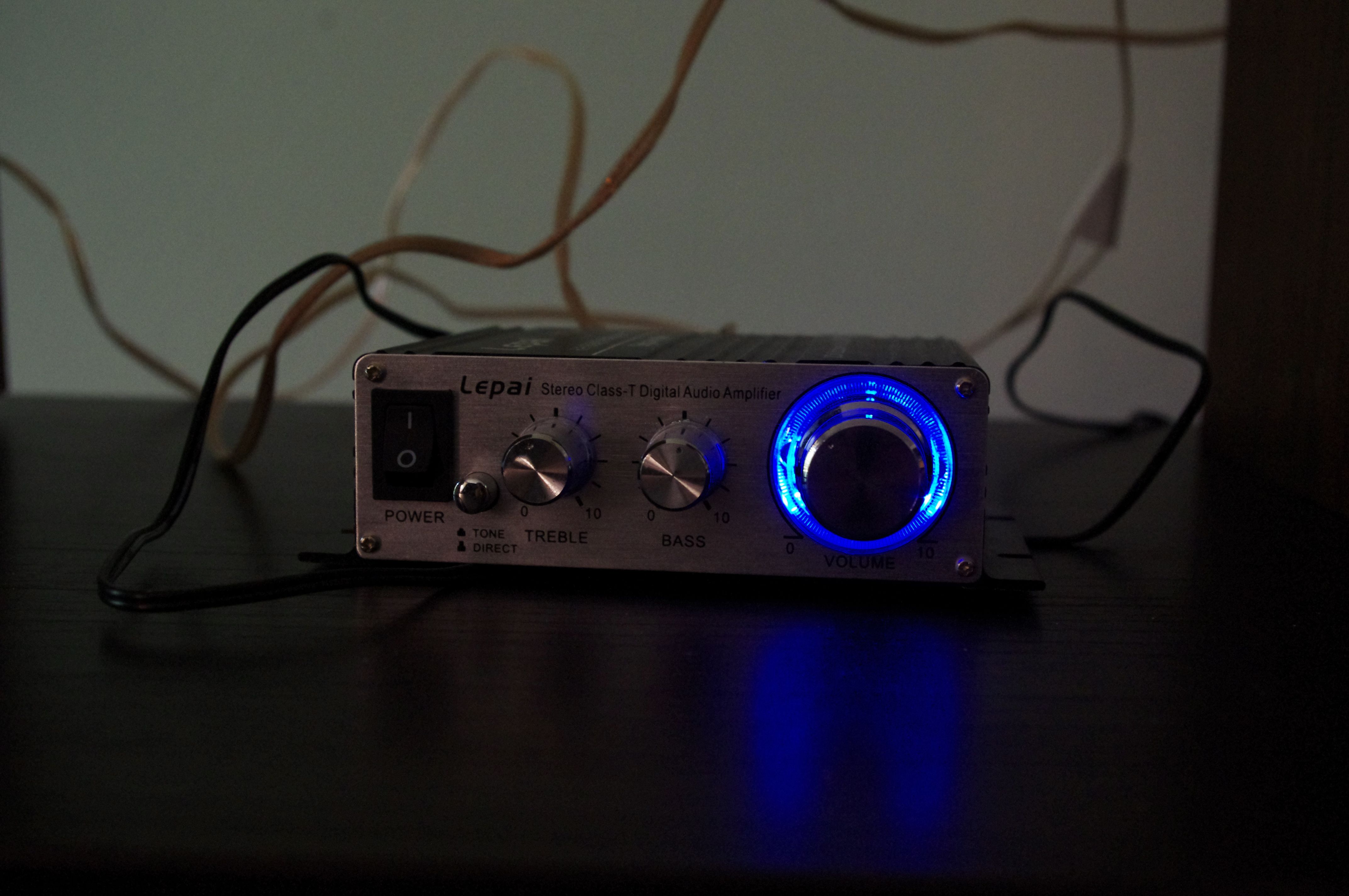
On the front there’s a volume dial which is backlit by a blue LED, two tone controls, a tone defeat button, the power rocker switch and a 3.5mm input jack. On the back a re speaker wire outputs for one set of speakers, RCA ins, and a hookup for the power adapter, which is almost as big as the amp itself. So all the important connections and pieces are there.

Lepai 2020+ front plate

Lepai 2020+ front plate

Hookup is simple. Plug in one set of speaker wires (The terminals look cheap but work fine), plug it in, and flip the switch. There’s an audible thump through your speakers as the amp’s relay closes. It’s louder than you expect but won’t be damaging anything. The blue LED around the volume rocker is very bright. In a dark room it could be pretty distracting.

So how does it perform?

Actually, pretty well.  It’s rated at 20w/channel, but folks who have tested it report you’re actually getting closer to 7w/channel of clean stereo power before clipping and distortion sets in.  For me the usable volume goes to about 11-12 o’clock on  the dial. I’ve tested this amp with Klipsch KG4s (94 db/w sensitive), Design Acoustic PS-10A (90Db/w), and Polk Monitor 5s (89Db/w) and they all get plenty loud, especially if you’re sitting relatively close. Songs sound pretty good. There’s good detail and clean reproduction throughout the frequency range – plenty of bass and high end.

For me, the amp sounds ‘just fine’ – I can’t pick out anything super special about it and it does nothing poorly. For the price I paid through Parts Express (about $25) this is an amazing steal.

Rear panel of the Lepai 2020+

Rear panel of the Lepai 2020+

What’s most surprising about this amp to me is what technology has accomplished. This amp uses the tripath chip, which is a sound chip developed in the early 2000s to provide audiophile-grade sound on an integrated circuit for a low price. Tripath technologies eventually went bankrupt in about 2007, but the chips persist and are catching on in the hi-fi world. A quick look on Amazon or Parts Express lists dozens of tripath-powered amps which provide cheap, low-maintenance and reliable sound. They’re even easy to mod!

I like this amp a lot for a few reasons – firstly it’s so small I can take it anywhere – it goes out on the deck to power barbecue speakers. It usually lives on my work table where I use it to test speaker projects in the repair or assembly stage. Currently it’s doing temporary duty in my HT room while we paint and all the big equipment is packed away.

The fact that this thing is ugly and only functional has its own endearing quality to it – I don’t worry about the aesthetics and just enjoy the music. it’s never going to be in my main rig. Wherever it is it’s there not to enrich my serious listening experience but to help provide background music. That’s important sometimes too.

What really surprises me is that this amp’s limitations also show me what my real listening requirements are. I can have a lot of music enjoyment and quite good sound on only 1-5 watts per channel. It makes you wonder why I ever switch on my 160 watt per channel Pioneer SX-150 to listen to Stevie Nicks 4 feet away from my speakers. I can’t be using more than one watt per channel.

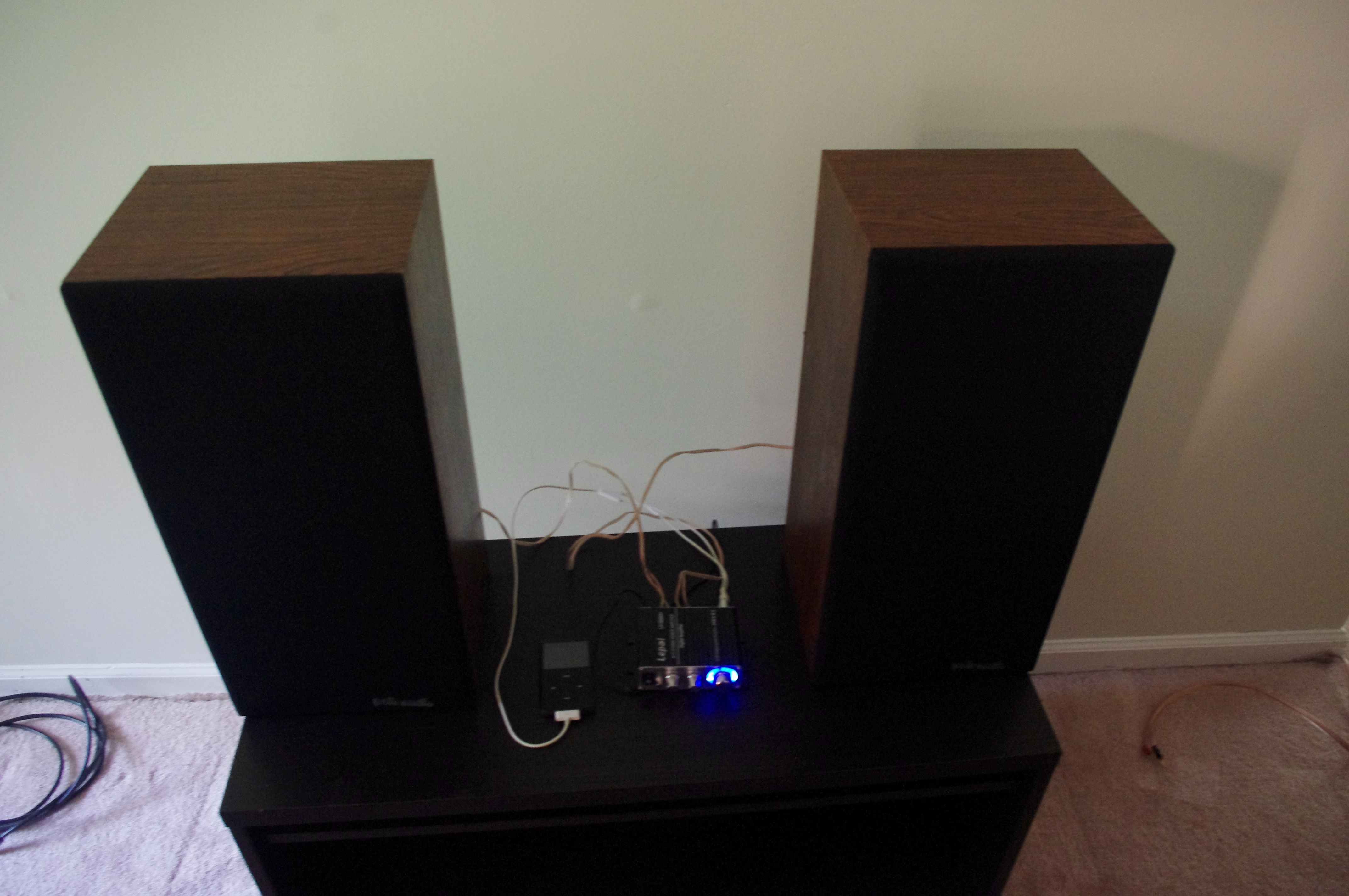
Lepai 2020+ in action with two Polk Monitor 5Bs while the rest of my gear is stored during basement renovation

Lepai 2020+ in action with two Polk Monitor 5Bs while the rest of my gear is stored during basement renovation

There are other limitations that aren’t so nice. For one, that thump when you turn on the amp. For really sensitive speakers, that could be a no-no. Also, when you add the tone controls to the signal path the amp gets noticeably quieter. That’s kind of cheap. And the thing is so light that it can be pushed around. But really, these are minor concerns.

If I weren’t such a style and brand snob, there’s no reason that this amp couldn’t be one of my main listening rigs. As it is, I think it’s a fine component for outdoor systems, for computers, workbenches, and garages. Its almost-vintage sound will not surprise those of you coming from lower-power classic amps (reminds me of my old Sansui 551 actually). And it’s the perfect size to be incorporated into projects like powered speakers, boomboxes, and outdoor or all-weather enclosures. What fun!

Swiss Army Stereo: Pioneer VSX-820K

•August 30, 2013 • Leave a Comment
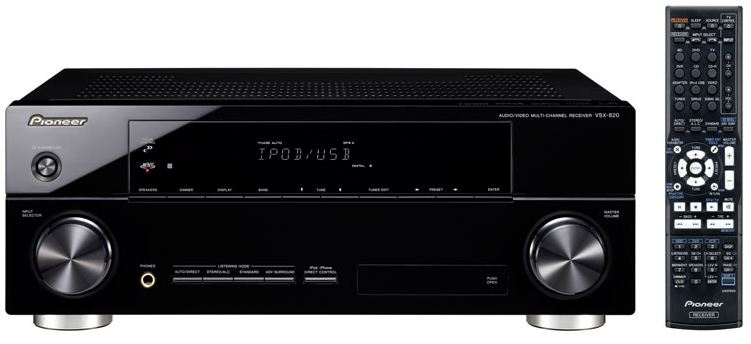
Pioneer VSX 820K. Image courtesy of Pioneer.

Pioneer VSX 820K. Image courtesy of Pioneer.


How did this get on here?

Isn’t this Silver Face Stereo?

Does circa-2010 now count as ‘vintage’?

Well, those are all good questions.

First off, this is Silver Face Stereo but I will make exceptions. And no, 2010 does not count as ‘vintage’, unless you’re talking about cell phones.

But my Pioneer VSX-820k does deserve a mention.

The VSX-820k is mid-tier in Pioneer’s line of consumer home-theater receivers. I think it retailed new for $3-400; I got mine in trade for other stereo equipment.

This is what comes in the package

This is what comes in the package

Style-wise, it’s almost literally nothing to look at: various sheens and textures of black plastic with a small LED front panel. Your basic black box. It does have two nice dials on the front for adjusting the volume and switching through inputs. This second dial is in my opinion almost useless, however.

On the back are the usual connections for HDMI, S-video and digital inputs, and 5 sets of 5-way posts for the 5.1 speaker out. There are also spring-loaded posts for the ‘b’ speakers. This model does not have preamp-outs, so there’s no way to hook up additional power amps should you be so inclined.


VSX-820K rear. Courtesy of Pioneer

VSX-820K rear. Courtesy of Pioneer

But that would really defeat the purpose of this system, which is to provide as much connectivity as possible without having to mess with more boxes or wires. HDMI means your player (Blu-Ray, DVD, Roku, cable box or whatever) only has to plug into the receiver once to deliver picture and multichannel sound. 5 power amps mean you don’t need additional amplifiers. And with the Pioneer’s 80 watts per channel, there’s sufficient power to get you started. And really, with all the speakers I’ve ever run on this system I’ve never really needed more power, at least that I could tell.

Oh, another interesting note. I think that the VSX-820k uses the same amplifier/s as its lower-tier (520k) and higher-tier (920k, 1020k) bretheren – I couldn’t discern any power or performance differences in the specs. So really moving up the chain you are not buying more power or sound, just more doodads and connections.

So how does it sound?

For movies and the like, it’s great. You can calibrate your system using the onboard automatic calibration microphone. You put the mic where you usually sit and let the system push pink noise to each speaker and determine the ideal EQ, sound level and distance. It works ok, but you’ll want to tweak afterwards. For example you can’t utilize a subwoofer if you have your front speakers set to ‘large’. Best to set them all to ‘small’ and dial in the subwoofer crossover level you want to use. I also appreciated dialing in more center channel then the system suggested. But that’s small potatoes.

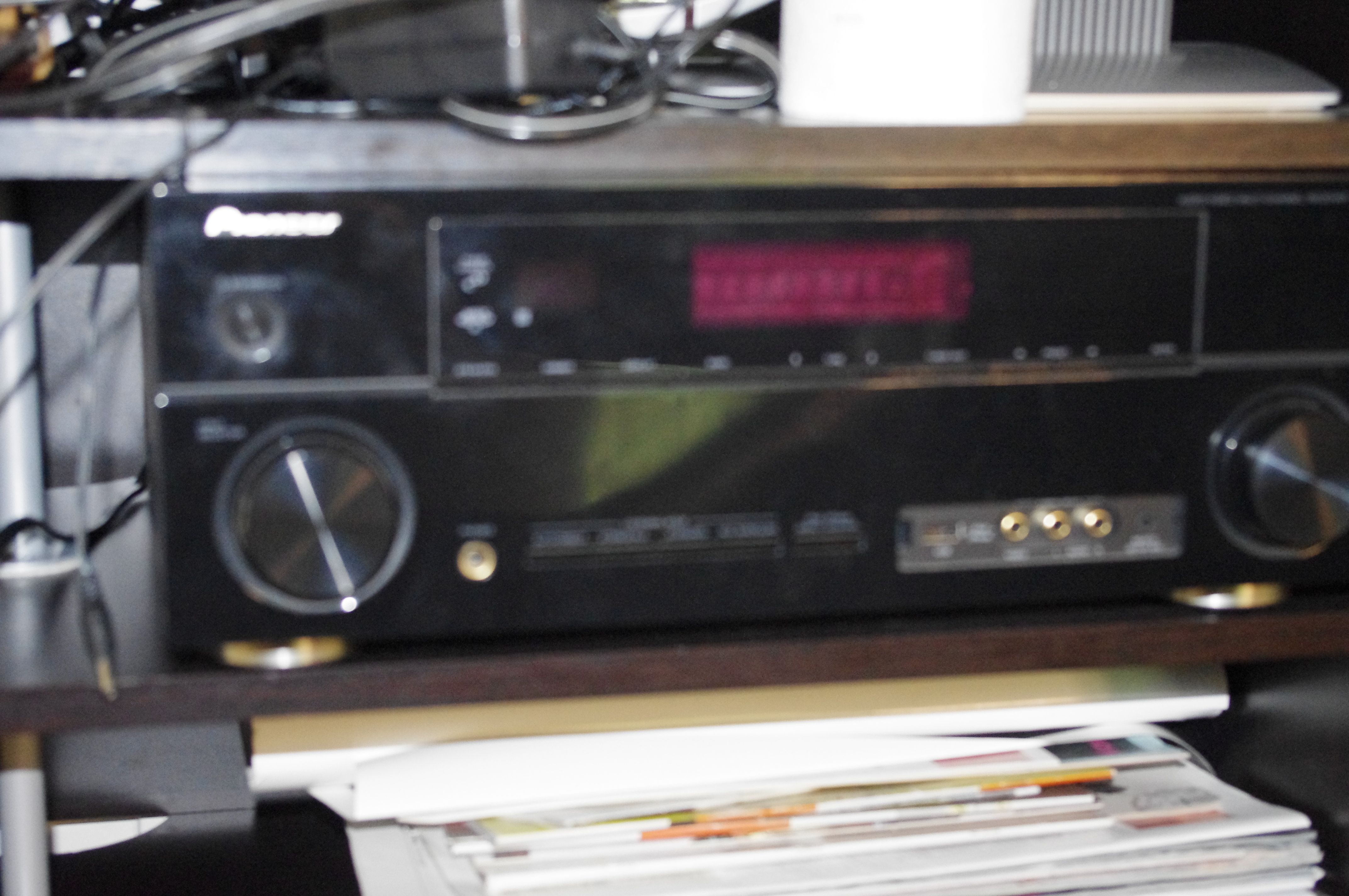
Here's my 820K, piled under cords while we redo the basement.

Here’s my 820K, piled under cords while we redo the basement.

Otherwise things sound good. Good speakers really help here too.

For music I really like this system too.

Sound is very accurate. It’s got a lot of high-end definition – treble and high notes come through clear and with distinction. it’s definitely a more ‘digital’ sound than the vintage units. But since I always initially judge receiver sound quality from detail, this unit stands out early.

It advertised 80 watts per channel but I suspect you’re really getting all that electricity only in 2-channel mode, so playing music on one of the 5.1 schemes the Pioneer has (5 different dolby settings from ‘theater’ to ‘concert hall’, Neo II 6.1, and others) less juice to push to each speaker. I currently have it hooked up to some larger speakers – Boston Acoustic A200s in the front, a Boston Acoustic VR-12C in the center, and Polk Monitor 5s as surrounds, and a B&W ASW600 subwoofer. It handles all of them just fine.

For me, listening to 2-channel music pushed to all 5 speakers was a little gimmicky – with the right speakers and placement this receiver is fully capable of creating a full soundstage in 2 channel mode.

So the electronic surround sound settings are not really useful. But other parts of this receiver’s prodigious processing power are.

I’m particularly fond of the automatic crossover settings that allow you to push only certain frequencies to your main speakers and pass on the rest to your subwoofer. This allows my main speakers to concentrate in the frequency range they’re best at without overextending trying to hit the lowest bass notes. For my Polk Monitor 7 and Boston Acoustic A200s that I use as main speakers, I usually set the crossover at about 80hz. This is even a little high for the Bostons but it really allows their sweet midrange to open up, and send the hardest low notes to the sub, in my case a Bowers & Wilkins ASW600.  You can get the same effect by running the speaker outs from a vintage stereo right into the subwoofer crossover and then have it run the higher frequencies to the speakers, but that is a bigger mess of cables. With the Pioneer all you have to do is shoot one RCA cable to the subwoofer and you’re done.

Another thing I do like with the Pioneer are the different processing schemes for 2-channel stereo. You can choose from ‘pure direct’ with is unadulterated sound from your source material. This usually sounds kind of thin. Or you can choose ‘direct’ or ‘stereo’, both of which have additional processing to bring more life into the sound. Basically what I think these do is pump up the gain and midrange. In any case it works to liven up the sound.

I listen to a lot of music from my iPod classic, and the Pioneer has a USB port and a special adapter to plug the iPod right into the receiver. You can actually control the iPod from the receiver remote, but I don’t – the remote and the onscreen interface for the receiver is terrible, something out of the MS-DOS era.

But what I do like is that the iPod direct-in allows the receiver to do some processing of the signal and use the Digital Analog Converter (DAC) in the receiver to improve the sound going out to the speakers. For listening to music in Mp3 or AAC format i think this is a huge help – the Pioneer does justice to the source material. On other amps my iPod just doesn’t sound as good. In particular moving to my Pioneer SX-1250 the soundstage from the iPod just isn’t as wide, I still have to do an A/B between the new and old Pioneers with other sources (CD, etc) to see how they stack up.

But overall, I am very satisfied with the Pioneer VSX-820. For someone who isn’t as obsessed with gear as me, this would be a very fine all-in-one system to enjoy music on.

How far can you go? Polk Monitor 7B Rebuild

•August 23, 2013 • 16 Comments

If you’ve paged through my blog posts you may know I like Polk Monitor series speakers. Especially the Monitor 7 series.

In my opinion, the Monitor 7s represent the the best balance of detail, imaging, and accuracy up and down the frequency ranges. They may not have as much rumble as their bigger counterparts in the series (10 and 12), but for what is essentially a 2-way 6.5″ bookshelf speaker that you can find for as little as $20, there is absolutely no equal.

what more could you want or need?

what more could you want or need?

I’ve had three pairs of Monitor 7s now – a pair of Monitor 7cs, Series II, and my Monitor 7Bs. I loved all of them, but my favorite of all is the earliest pair, the 7Bs, with the legendary Peerless tweeter.
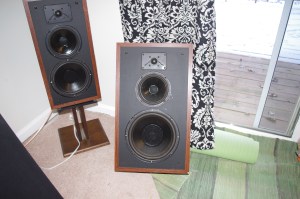
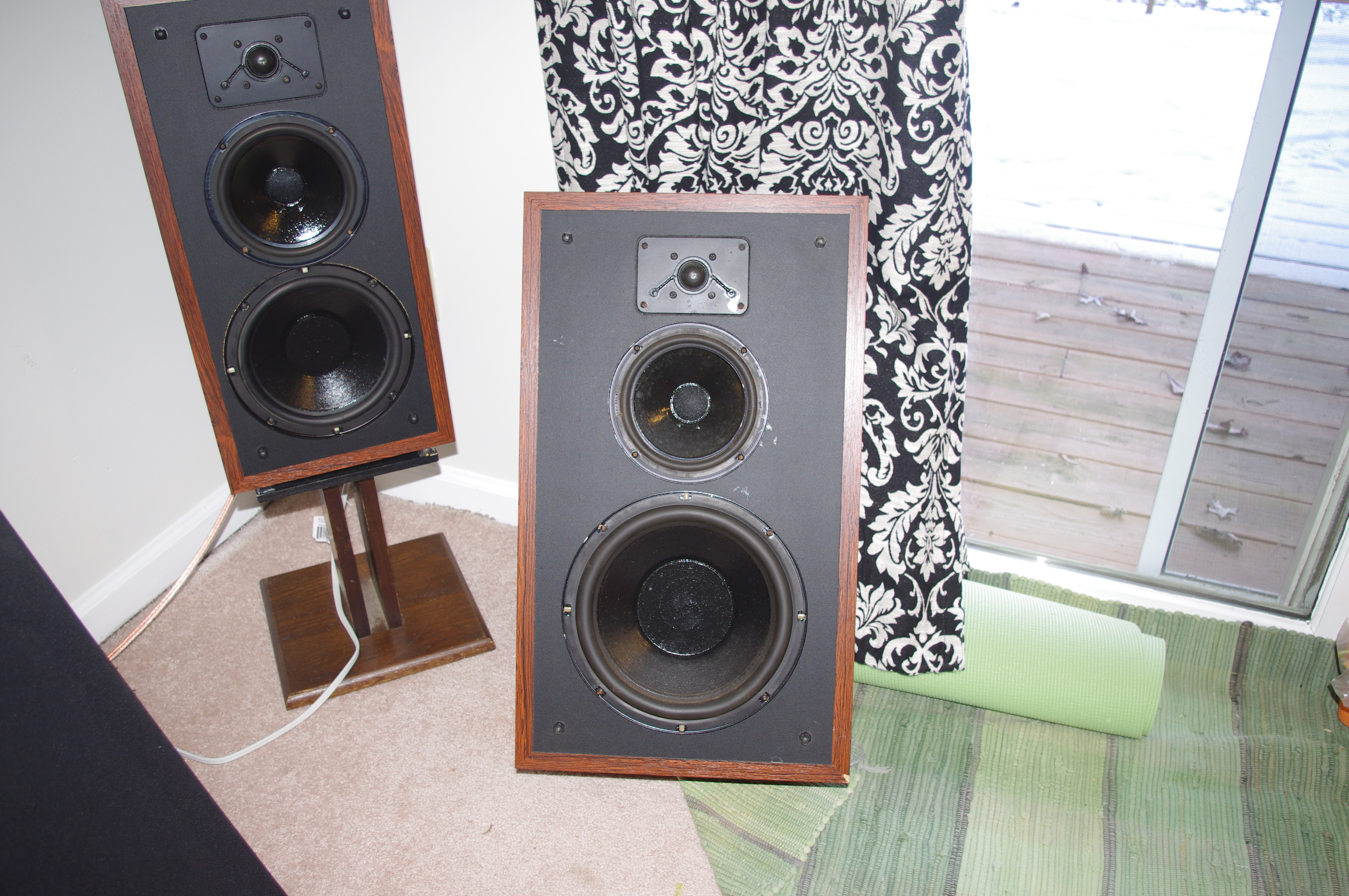
My Polk 7B alongside its little brother the 5B

My Polk 7B alongside its little brother the 5B

I got turned on to the Polk online forum early on in my Polk hobby (www.polkaudio.com/forums). In addition to some of the most helpful and knowledgeable folks in the audio internet, the Polk Forum is home to a trove of information on mods and restoration tips for Polk speakers, maintained by a dedicated and friendly group of tinkerers. Some of their expertise deals with cheap fixes and quick mods, but just as much of it focuses on taking the impressive Polk speakers to the next level and then some. Some of the mods discussed can cost hundreds or thousands of dollars.

Hundreds for a speaker that can be found for $20-100 in good condition? Why? How can you justify that kind of outlay for mods on what many audiophiles consider a somewhat modest speaker?

Well, because in many cases these mods are blessed by Matthew Polk himself. And I don’t care if the audiophiles turn their noses up at the Polk line. They are amazing speakers, and the SDAs especially deserve their cult status. And trust me until you’ve heard a pair of SDA-1 with Larry’s Rings, Clarity Caps, and the RDO-198s, you haven’t lived.

These are not mine, but what a collection! - credit here: http://www.avsforum.com/t/618137/calling-all-polkies-official-polk-thread/18240

These are not mine, but what a collection! – credit here: http://www.avsforum.com/t/618137/calling-all-polkies-official-polk-thread/18240

And what’s more, Polk, in addition to fostering a close relationship with its clients, is honest with them. The company has noted that the speakers it made in the 70s and 80s were great, but could have been much better had the designers been able to take them where they wanted to outside of the limitations of the pricing constraints of the market. When you realize that materials only comprise up to 20% of the cost of a home audio speaker system, you realize how many design and component compromises must take place even in a $400 system like the original Polk 7s. It’s amazing that the company was able to build such high performing components!

For that reason, Polk has supported the belief that, especially for its older lines of speakers, advances in component technology (particularly in crossover components) and no limits on components budgets mean that owners can, for a limited additional outlay, take their speakers to the higher levels of performance than the designers originally could have due to those final cost limitations. That, paired with the low cost of these speakers on the secondary market now, mean that hobbyists can build speakers that rival new audiophile designs costing much much more.

So how much could an additional hundred dollars get you in sound? Could it get you to the level of a $1,000 monitor system?

I decided to find out.

I pulled my beloved 7Bs apart and decided to see how far they could go. Or, rather, how far I could take them, by doing the main performance modifications recommended on the Polk Forums. These modifications are designed to upgrade the crossover components to a higher standard, eliminate resonance and ringing from within the cabinet and from the baskets of the speaker and passive radiator, and tighten the seal between the speakers and the cabinets.

Since my speakers were also not the prettiest to look at, I also decided to try my hand at re-veneering the cabinets to make them more attractive.

So here’s how it went:

1. The first thing I did was disassemble the speakers completely and bag all the pieces: drivers, tweeters, and passive radiators, as well as the crossover/terminal cup and the batting contained behind the tweeter inside. I marked all the wires on the crossover cup as I disconnected them from the speakers so as not to mix up the mid and tweeter hookups.
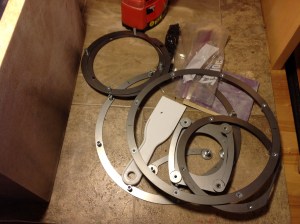
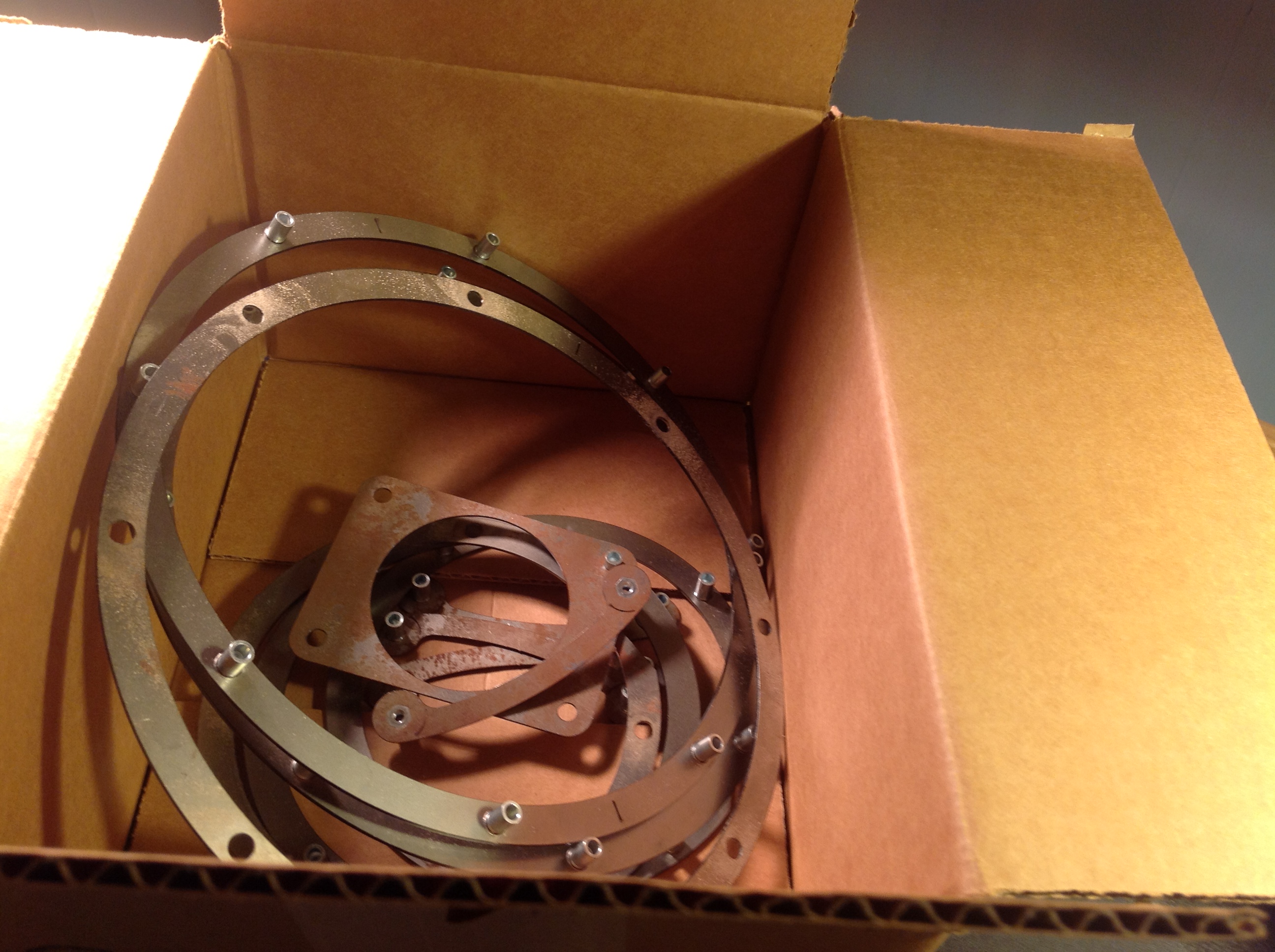
Larry's rings and blanks and assorted parts and tools

Larry’s rings and blanks and assorted parts and tools

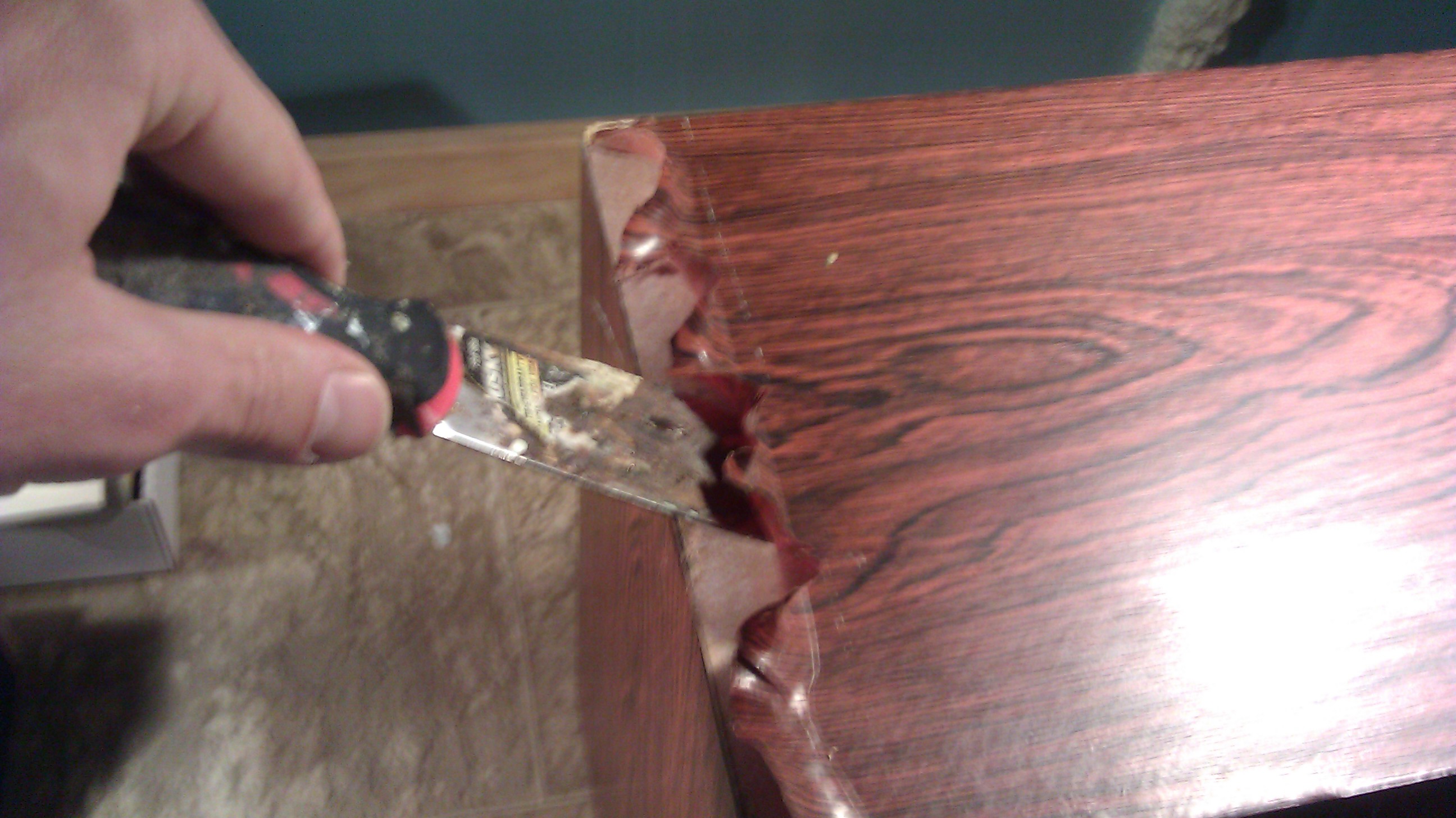
2. After pulling everything apart, I started on the cabinets. The old vinyl covering was scratched and kind of icky looking. In my opinion, the biggest drawback of the Monitor series is the generic covering on many of them. Especially on mine, the woodgrain covering is not very convincing. Other coverings (especially the grained rosewood and oak on later models) are much better. I took my clothes iron and, using a cotton cloth as a buffer, began to heat the vinyl to melt the glue. With enough heat, the vinyl pulled right up. It was a long and tedious job, and my fingers ached afterward. Not much fun, but once the vinyl was off I had some clean speaker cabs!
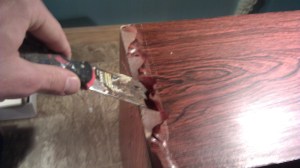
Peeling vinyl woodgrain off of the Polk 7Bs

Peeling vinyl woodgrain off of the Polk 7Bs

Iron-off vinyl veneer. Crummy work

Iron-off vinyl veneer. Crummy work

3. I taped and re-painted the bare mdf on the back edges of the cabinet to a dark black. I also sanded the mdf cabinet sides a bit and added some putty to dinged corners to even things out.
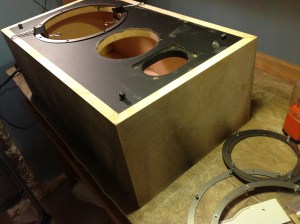
Bare MDF cabinets ready for rings

Bare MDF cabinets ready for rings

4. My next stop was the veneer. This was absolutely uncharted territory for me so I tried to do as much research as possible before buying materials, and especially before cutting wood! After research I decided to go with a Cherry veneer – I like a bit of a redder color, and liked the idea that the wood could age and change with time. Cherry has a neat grain, and is cheap to boot. I did invest in cherry veneer with a peel and stick backing. This basically takes your basic paper-backed veneer and adds a 3M adhesive that’s ready to go. In my opinion it’s a no-brainer – I saved a ton of time by not having to spread glue on surfaces, let it dry, and then re-activate through heat. Definitely recommended.
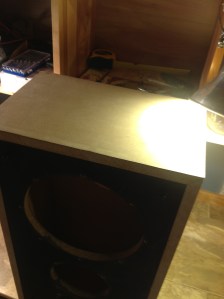
Polk with fresh cherry veneer applied. Hurray!

Polk with fresh cherry veneer applied. Hurray!

Applying Cherry veneer sheets. Tools of the trade behind.

Applying Cherry veneer sheets. Tools of the trade behind.

A few other tools I bought that helped a ton were a veneer spreader and a edge bander. The veneer spreader applies even pressure to smoothe out the veneer on the surface, and the edge bander is an easy way to quickly and evenly trim extra material off of the edge of a veneer sheet once’s its affixed to the surface.

I made close measurements of each side and cut them out of the veneer with a razor, leaving about 1/8″ extra on all sides. I then lined up the sheet over the paned with the backing still on to test fit. To help me line up the veneer for application, I used little pencil lines to help line up the sheet.

Once you pull off the adhesive backing, you only have one go at applying the veneer – you cannot pull it back off. So get it right!

Once the veneer was on, I smoothed it down with the spreader and used the edge trimmer to get the excess. Then on to the next side. Once I got the hang of this process, it wasn’t hard. The toughest part was doing the thin front face pieces, which fit together with angled edges. There is probably a technique to cut these and make it easy but I don’t know it. I had to eyeball it. It came out pretty well, but not perfect.

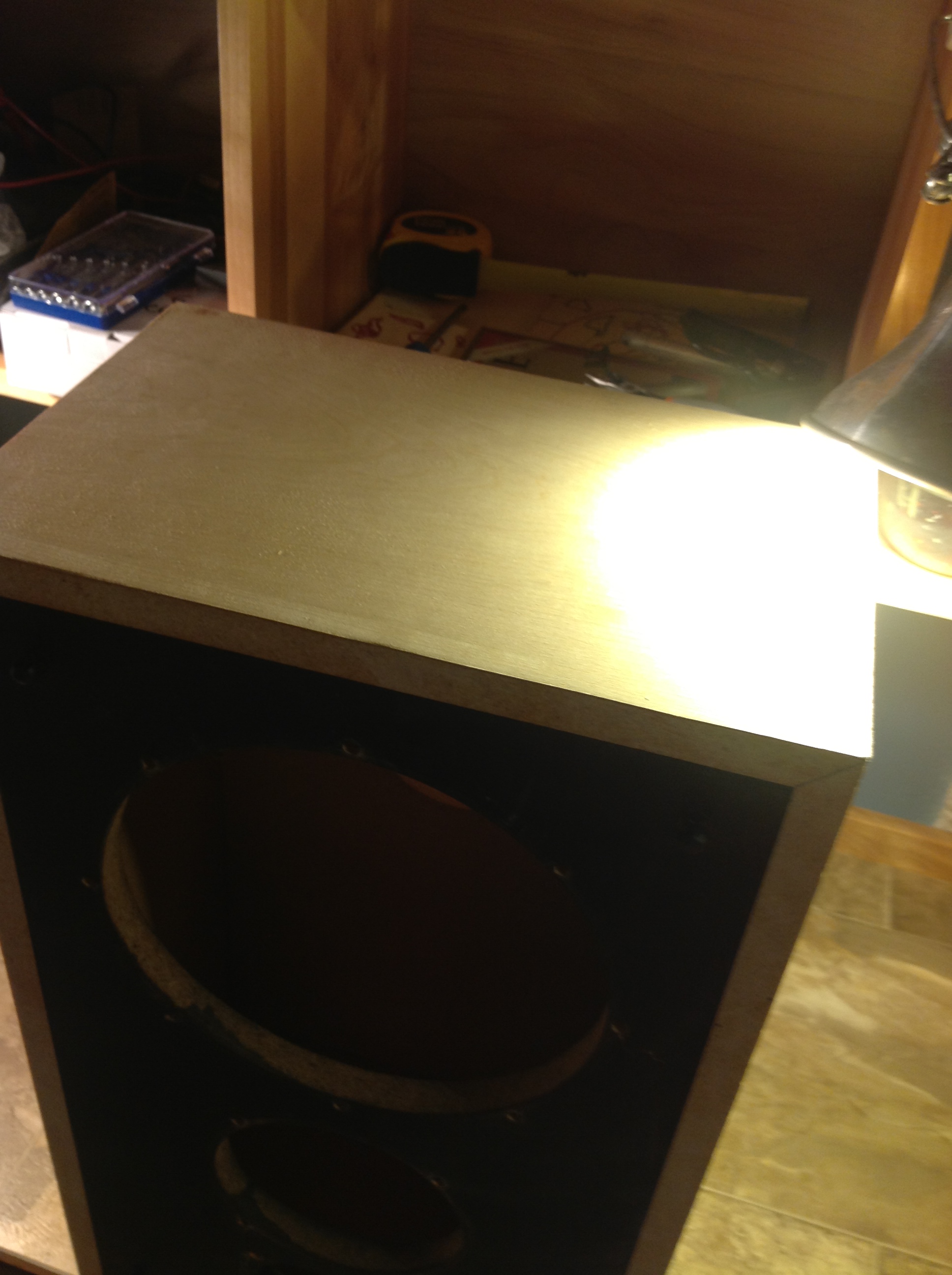
After everything was on, I sanded and smoothed out the finish, and applied a water-based stain. I then used a satin-finish rub-in polyurethane sealant to give the cabinets a nice gleam. It took 3 coats but the result was very nice – a subtle shine and deep finish.

This is about the simplest sealed finish you can go with. It would be easier to use an all-in-one stain poly or an oil I guess. But I wanted a nice coloring and when I did the stain I wasn’t sure about what finish I wanted to use in the end.

veneered and stained cabinets with PR an woofer on top receiving their dynamat

veneered and stained cabinets with PR an woofer on top receiving their dynamat

The lesson I learned in the veneering and finishing is get it right at the beginning – You can’t cover up bad veneering with stain, finish, or lacquer. Same thing with incomplete sanding or poor staining, so get every stage right and take your time. I’m very happy with these for my first effort but they are by no means perfect. But do they look better than the original vinyl? Oh yeah.

For next time I will spend more time carefully sanding the veneers down to uber-smooth and looking for sanding marks – it was only when I applied the stain that I saw I still had some in my wood. I also didn’t sand between applications of stain. This is important because the stain can make the grain of the wood raise, which requires additional light sanding to put down, followed by more stain. As it is my veneers have a little more texture than I would like.

I also learned that it’s best to stain slowly and in a fully-lighted environment. Duh. I finished one side as dusk was coming and missed that some extra stain had seeped over a joint, leaving a dark line on another panel of the speaker. So sad. But hopefully I will be the only one who notices.

After the staining and sealing, I moved on to the hardware improvements.

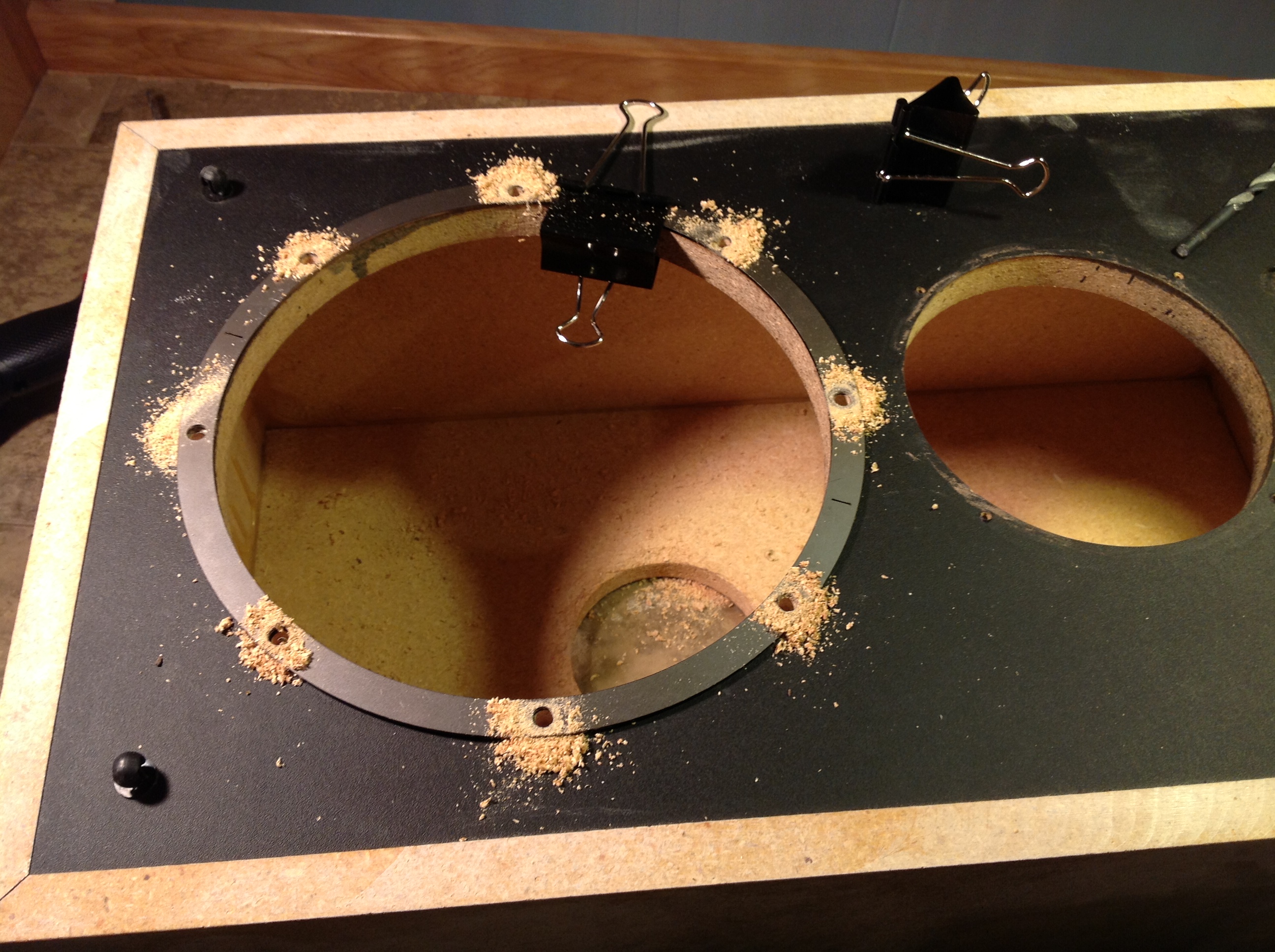
5. My first stop was Larry’s Rings. These rings, available through the Polk Forum, enable you to effectively ‘clamp’ your drivers and passive radiators to the cabinet, instead of screwing them into the plywood. This allows you to make a much tighter connection with the cabinet without damaging the wood, and gives a better seal. This required drilling new sink holes in the cabinets for the rings to fit into. Not too bad.
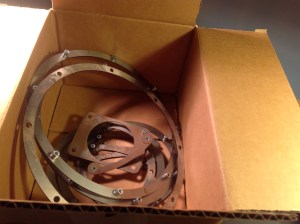
Rings, straight from Larry

Rings, straight from Larry

Applying the rings. First thing was to drill new pilot holes

Applying the rings. First thing was to drill new pilot holes

6. The next step was to fit some acoustic barrier insulation into the back, sides, and bottom of internal cavity of the speaker cabinet. The purpose of this is to eliminate resonance and reflective sound within the speaker cavity, improving the clarity of sound. I didn’t use a ton of this material to coat the entire inside of the cabinet because I didn’t want to cut down the volume of the cavity by too much, which could change the frequency response of the speaker. I also felt that some material on all surfaces would break up the reflectivity enough to keep resonance down.

7. My next job was to dampen the basket of the mid-woofer and the passive radiator. Both of these components are made of stamped steel frames, which are thin and can ring, introducing unwanted sound and resonance. I used a duramat-like material I found on the Parts Express website. I cut pieces out and used the included adhesive backing to fix them on to the metal baskets. I used pieces of varying sizes to make as full of coverage as I could. One tip- don’t go too far down on the woofer and passive radiator, or they won’t fit flush in the holes in the speaker cabinet. I learned that the hard way.

Now on to the crossover. The components here are arguably the most important part of the modification and restoration. There is a ton of material on the web and in the Polk forum on how to modify crossovers. Great debates are fought over the best components, what needs to be done and how. Some people spend hundreds of dollars on individual replacement capacitors. My budget was limited, so I researched to find the consensus on what needed to be replaced and what level of component quality would represent the best mix of quality for the cost. I settled on Dayton Audio 1% capacitors and Mills resistors. I think my total outlay for these components was likely around $50. I looked into replacing the inductors, but the opinions on the utility of this were mixed, as were about how important it was to exactly match the DC resistance of existing inductors. With that in mind and minding my budget, I decided to leave the existing inductors in place.
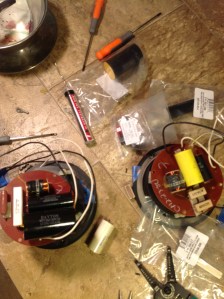
Polk Monitor 7B crossovers. On left is a finished one, on right is the original. Not too bad.

Polk Monitor 7B crossovers. On left is a finished one, on right is the original. Not too bad.

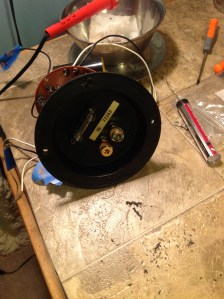
I also bought new gold heavy-duty 5-way binding posts. I drilled out the old posts and put these new ones in. They’re huge- they almost didn’t fit under the crossover circuit board on the back of the terminal cup. But they look awesome and most importantly easily accept high-gauge bare wire, something that the old posts would not do. One tip – the old binding posts are covered in hot glue to seal them. Use rubbing alcohol to loosen the old glue – it comes right up.
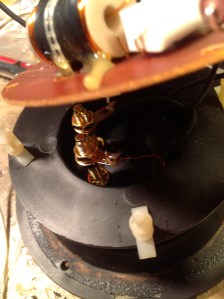
New binding posts. They look sweet and are heavy duty.
New binding posts. They look sweet and are heavy duty.

New binding posts from the back. They are very easy to use.

New binding posts from the back. They are very easy to use.

Soldering in the new crossover components wasn’t hard at all. One thing that made it even easier was de-soldering the inductor wire from the crossover board, which allowed me unfettered access to the bottom of the circuit board. Definitely do this. After that it was as simple as pulling out the old resistors and caps, and putting in the new ones. Everything fit without any modification or fighting.

After all the new parts were in, I tested the crossovers on my bench by hooking up the speakers and putting on some music. Everything worked, so I sealed everything in place with some hot glue to damp vibrations and set it aside.

8. Now came assembly. The first thing to do is to put all the Larry’s rings into place, followed by the batting behind the tweeter. I bound the batting with line to compress it and make it easier to stuff back in. You want the batting to be compact and stay behind the tweeter and not fall down to the woofer or passive radiator.

9. Then I put some foam insulation tape on the back of the terminal cup and screwed in the terminal and crossover. I ran the speaker wires out through their respective holes and taped them down so they wouldn’t move. Then I put in the tweeter, soldering the wires onto the speaker. Then came the mid-woofer, followed by the passive radiator.

The passive radiators would only go in without the foam insulation backing. I was using an insulation with a thickness of over 1/8″, which wouldn’t allow the radiators to tightly screw into the rings at full compression. So off the insulation came. After assembly and leak testing of the speakers, I found that there is some air leakage. I’ll have to re-assemble with either a Mortite sealant or some real armacell.

Once everything was in I rushed them out for a demo on the stereo. As expected they sound great. There is accurate and pleasant sound well balanced through all frequencies. Imaging is excellent and bass response, even with some air leakage, is very good. The tweeters are still a bit laid back as before but the detail and frequency response is there. I am very satisfied. With a little more time on them, I plan on doing an A/B test with my Boston A200s, which prior to the restoration bested the Monitor 7s in midrange and oomph. We’ll see how they fare now.
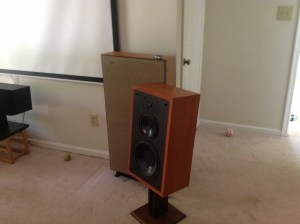
Polk UberMonitor 7 in front of its rival the Boston A200
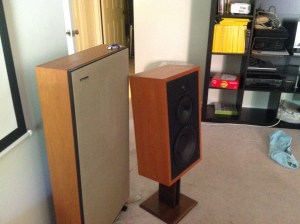
Polk UberMonitor 7 in front of its rival the Boston A200

Another view of the Cherry Red Polk

Another view of the Cherry Red Polk

I’m also going to wait a while for a definitive test, as my research has found that a proper burn-in of the capacitors only occurs after approximately 100 hours of use. But I can say that even at this early stage I am very satisfied!
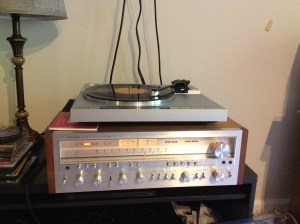
Recapped Pioneer SX-1250 and Yamaha P-520 spinning some vinyl

Recapped Pioneer SX-1250 and Yamaha P-520 spinning some vinyl

Lesson: Some hard work and not too much money can give you some serious improvements to the Polk Monitors. And you can have real pride of ownership over some speakers you practically build yourself.

The performance-related modes (crossovers, rings) are not hard to do.

Re-veneering the cabinets is another story. The result was good and gratifying but the work is hard. At least for me it was.

I hope this post helps anyone else considering a similar mod

Quick update – fantasy gear, my Pioneer, ins and outs

•July 29, 2013 • Leave a Comment

Hey all,

A quick update – hopefully in the coming weeks I’ll write more on some of my comings and goings:

– The AMT-1s have left the building – I just couldn’t get into them. The tweeters seem really cool and the design is pretty funky but the overall effect was lackluster to me. Someone else wanted them much more than I did. Until I went to Capitol Audio Fest…

– My Pioneer SX-1250 is back from restoration. Full recap. Sound = amazing. I sent it to a fellow vintage gear aficionado named Eric who is a master at making the electrons flow. We demoed the restored unit on his modded Tannoys. I was in heaven.

– I have a new set of KLH 20s in. They look good cosmetically. All drivers work but the crossovers are dead. So they go on the pile for a recap.

– My Polk 7s are still apart. Cabs are re-veneered and the crossovers are recapped. All I have to do is seal the cabinets and put it all back together.

– I’m amassing a small but growing vinyl collection.

-I went to Capitol Audio Fest this weekend. An insane collection of the most over-the-top audio in the world, at least in my opinion. Cables that cost more than my car, speakers that cost more than my house. The most impressive speaker there was topped off with a set of AMT tweeters like the ones I just sold. Damn!

Transformative: ESS AMT-1

•June 16, 2013 • Leave a Comment

Just in – a pair of ESS AMT-1s. These look to be very early specimens, likel early 1970s. These are ported, unlike later versions with passive radiators. They are in great condition and everything works. I just started demoing them and am not finding a lot of bass. But the tweeter is really sweet. More to come. IMGP2606

IMGP2605

IMGP2603

IMGP2604

IMGP2602

IMGP2600

IMGP2601

In and out: Pioneer SX-727, SX-750, Denon AVR-1907

•May 3, 2013 • 5 Comments

I like speakers and I like receivers. For whatever reason I feel fine keeping a large stable of speakers around, but I get the urge periodically to clean out all of the older receivers I have laying around not being enjoyed on a regular basis.

First up was the Pioneer SX-727. This was an example of what some consider the high water mark for Pioneer’s receiver line – heavy metal components, real wood (even on midrange models like this one), thick glass display windows, solid sound. This 727 was no exception. It was built like a tank, and even after 39 years, played solid. It came missing a loudness button but I was able to find one off of eBay for $10. Then it was perfect. Sound quality was high, and the capability of the FM tuner was amazing! I paired it with a set of the Realistic Nova 8s, and the sound was pure vintage. But with everything else in the house, this didn’t get a lot of air time. The pair went to one very happy budding vinyl aficionado.

Pioneer SX 727. What a beautiful machine. this pic is not of mine however...

Pioneer SX 727. What a beautiful machine. this pic is not of mine however…

Pioneer SX 727 rear

Pioneer SX 727 rear

It was interesting to contrast that tank with the Pioneer SX-750, a model in the same spot in Pioneer’s model line from only two years later. Weight was down considerably, the real wood cabinet had been replaced by gossamer vinyl woodgrain stickers, and the rear panel was more basic. Cost cutting had taken hold of the Pioneer line, at least in the lower reaches. The front panel was still high-quality aerospace aluminum, however, and looked the look. The sound was still good, with that characteristic Pioneer thump on the low end. Ironically, neither the -727 or -750 put out anywhere near the effortless bass of my SX-1250 (pre resto) at the same volume level. I never would have expected that, but I guess effortless power reserves do have their place. Who knew that 160wpc could be felt at lower listening levels, or that 45wpc wouldn’t get the job done? The 750 also went home with someone ready to enjoy it for its formidable phono preamp.

My Pioneer SX 750

My Pioneer SX 750

Pioneer SX 750. Plastico woodgrain no match for the real walnut on the 727

Pioneer SX 750. Plastico woodgrain no match for the real walnut on the 727


The Denon AVR-1907 was the surprise. For a modern AV receiver ,this thing rocks. Probably weighing in at over 40 lb, this receiver was also biamp capable, meaning that the max 110wpc at 6 ohms could be bridged to 220 by switching the second room speakers to the biamp mode. I never used it for anything other than music playback from my iPod and it impressed with effortless clarity. It had the whole compliment of decoders, Dolby effects, multi-channel speaker outputs and full preamp outs (!) but I never used any of that. The sound and power was great and really complimented the B&W 601s. But for what I used it for it was far too complicated – I never even figured out how to set the bass and treble. It found a willing and happy home. I was sorry to see it go.

Denon AVR-1907. Not much to look at, but good to listen to

Denon AVR-1907. Not much to look at, but good to listen to

Denon AVR-1907. Complicated.

Denon AVR-1907. Complicated.

Realistic Nova 8

•May 3, 2013 • 4 Comments
Realistic Nova 8 Speakers

Realistic Nova 8 Speakers

Two pairs of these came home with my Pioneer SX-1250. They were part of the deal – if I wanted the Pioneer, I had to take the Realistics.

I already had a pair of Realistic Nova 6Bs at home and I knew that despite the lack of brand cachet, I knew that the Nova line could produce. I hauled the four speakers home in my car with the receiver. This was a workout – the Pioneer weighs over 60 pounds and I estimate each one of these big Novas weighs over 40!

The first thing I noticed with the Nova 8s was the deep walnut veneer. These are easily as high quality in build and finish as my KLH Model 6, the Pioneer CS63DX or HPM 100s that I had. Getting them home I also noticed that thankfully these two pairs had almost no dings or scratches. A deep wash with soapy water and 100-grit steel wool pulled off the dirt, and some Howard’s Restore-a Finish and Feed and Wax brought them back to life nicely.

Deep walnut veneer on the Nova 8
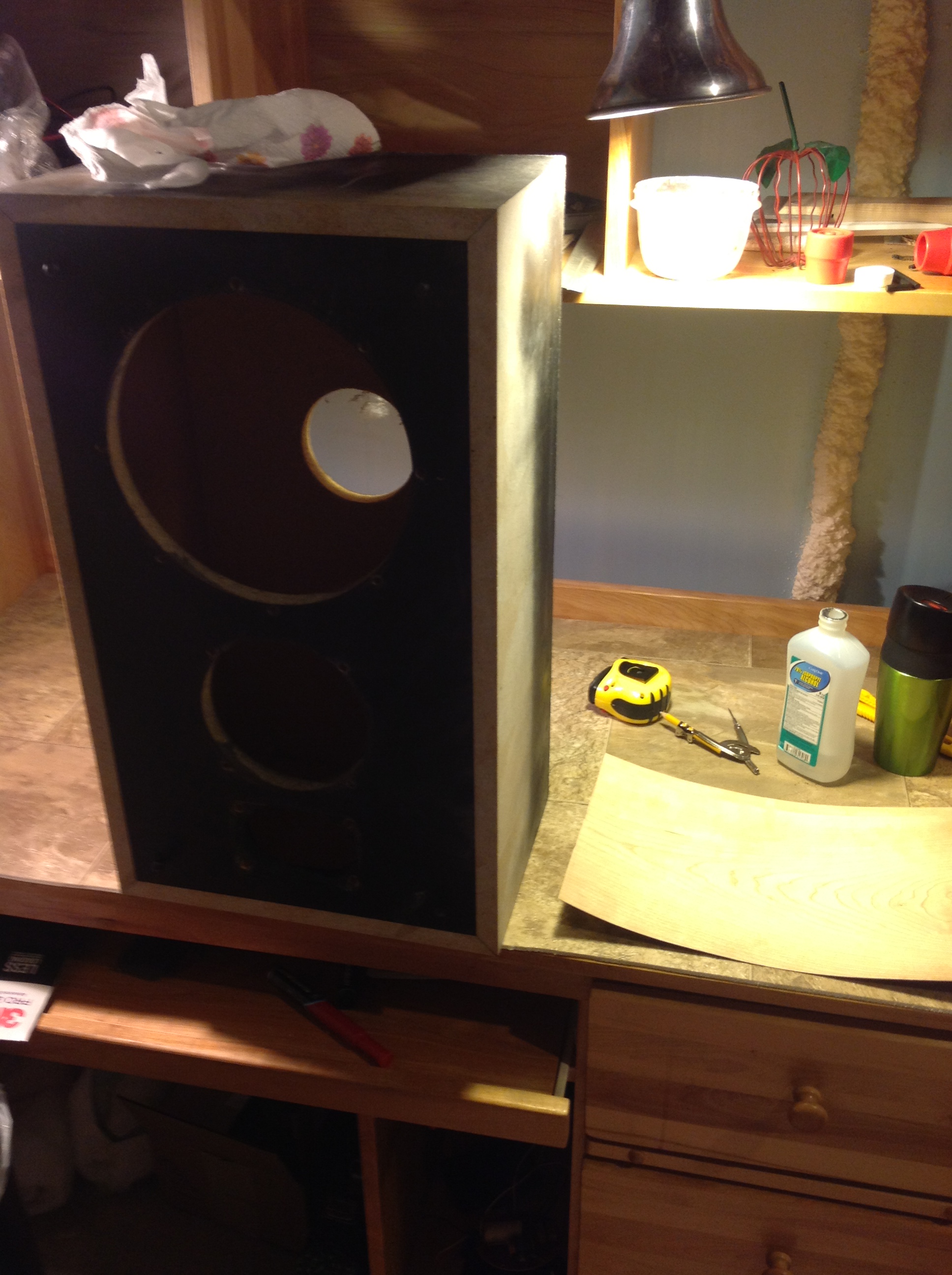
Deep walnut veneer on the Nova 8

Wax brings out the shine on the Nova 8s

Wax brings out the shine on the Nova 8s

Internet reviews of these speakers are intriguing. For a lesser-known speaker it has a lot of adherents. Reviews are overall positive, however a few concerns were raised – tweeters seem to die with some frequency in these speakers, and they are sensitive to listener position. More on that in a moment.

So how did I like them?

Well, even before  I cleaned them up I had them hooked up to the stereo for a test. They sounded big, and very warm. Thick could be the best description. Highs were definitely in the ‘vintage’ rolled-off range, and the midrange was very rich. Lows got low however for a 12″ woofer bass wasn’t massive. The sound (or lack thereof) was not due to dead tweeters – I tested every driver individually for response on the workbench.

Nova 8 rear panel. Two tone pots and those little Realistic screw wire inputs. The hole in the center is for a proprietary stereo wire plug.

Nova 8 rear panel. Two tone pots and those little Realistic screw wire inputs. The hole in the center is for a proprietary stereo wire plug.

Sitting dead-center between the speakers with them pointed in your general direction sound and imaging was pretty good. moving off axis however was even more interesting – it seemed that ‘holes’ would develop in the frequency range at certain spots at an oblique angle from the speaker. The effect was slight but noticeable. This tone aberration was mentioned online as well, perhaps a result of the double midrange and tweeter operating in the same frequency ranges.

What?

The Realistic Nova 8 and 8B are 3-way, 4-driver speakers. They have a 12″ woofer, and 3 3″ drivers which produce the mid and high frequencies. Those three drivers, two midrange and one tweeter, are identical, at least in outside appearance. They all also operate in the midrange, with the tweeter extending into t he highs. An interesting system to be sure. And one which evidently produces some tone overlap or cancellation at certain angles from the speaker.

The Nova 6Bs I had woke up like Sleeping Beauty with a recap, and I would only assume that these would be even more amazing with new capacitors. The crossover is simple and easy to work with, and it couldn’t be easier to get to it – the woofer unbolts and after removing some fiberglass there everything is.

The Realistic Nova 8 driver compliment. The midranges and tweeter sure look the same to me, but are marked differently on the magnets.

The Realistic Nova 8 driver compliment. The midranges and tweeter sure look the same to me, but are marked differently on the magnets.

There are others who have built completely new crossover designs for these speakers, with reportedly stupendous results. Others pull out the original drivers and do an Econowave project with the sturdy cabinets. I would be interested in experimenting with either, but given the multitude of other projects in line, I doubt I will ever get to them.